Gen Z housing hotspots: Southern metros lead in renter growth while buyers turn to the Midwest
Share this article:


Tech-savvy, connected, and financially conscious, Gen Z is stepping into the housing market with confidence — and reshaping it in the process. In just five years, the number of young renters reached 4.4 million from just 700,000, marking a sixfold surge that’s redefining hotspots from Birmingham, AL, to San Jose, CA.
While most young adults still rent, the number of homebuyers in their 20s is rising at a faster pace, even though they still represent fewer than 1 million households. In fact, only 17% of Gen Zers own a home, far behind Millennials who first transitioned to owner-majority back in 2022.
To understand where these young adults prefer to rent or buy, we analyzed 97 U.S. metro areas with at least 15,000 Gen Z households and highlighted the locations with the biggest gains.
- Gen Z renters increased sixfold in five years, adding 3.7 million households nationwide.
- Southern metros are leading the growth with Birmingham AL, at the top after a thirteenfold increase.
- Coastal cities continue to claim the highest concentrations with San Jose, CA, leading at a 95% share of Gen Z renters.
- Gen Z homeownership remains limited at just 17% and is growing fastest in affordable, mid-sized markets.
- Ogden, UT, has the highest share of Gen Z homeowners with 41% of Gen Z households owning their homes.
By looking at the numbers, one thing is clear: Young adults are drawn to places with good jobs and rising wages. However, this doesn’t always mean big cities on the coasts, but also new youth hubs in the South.
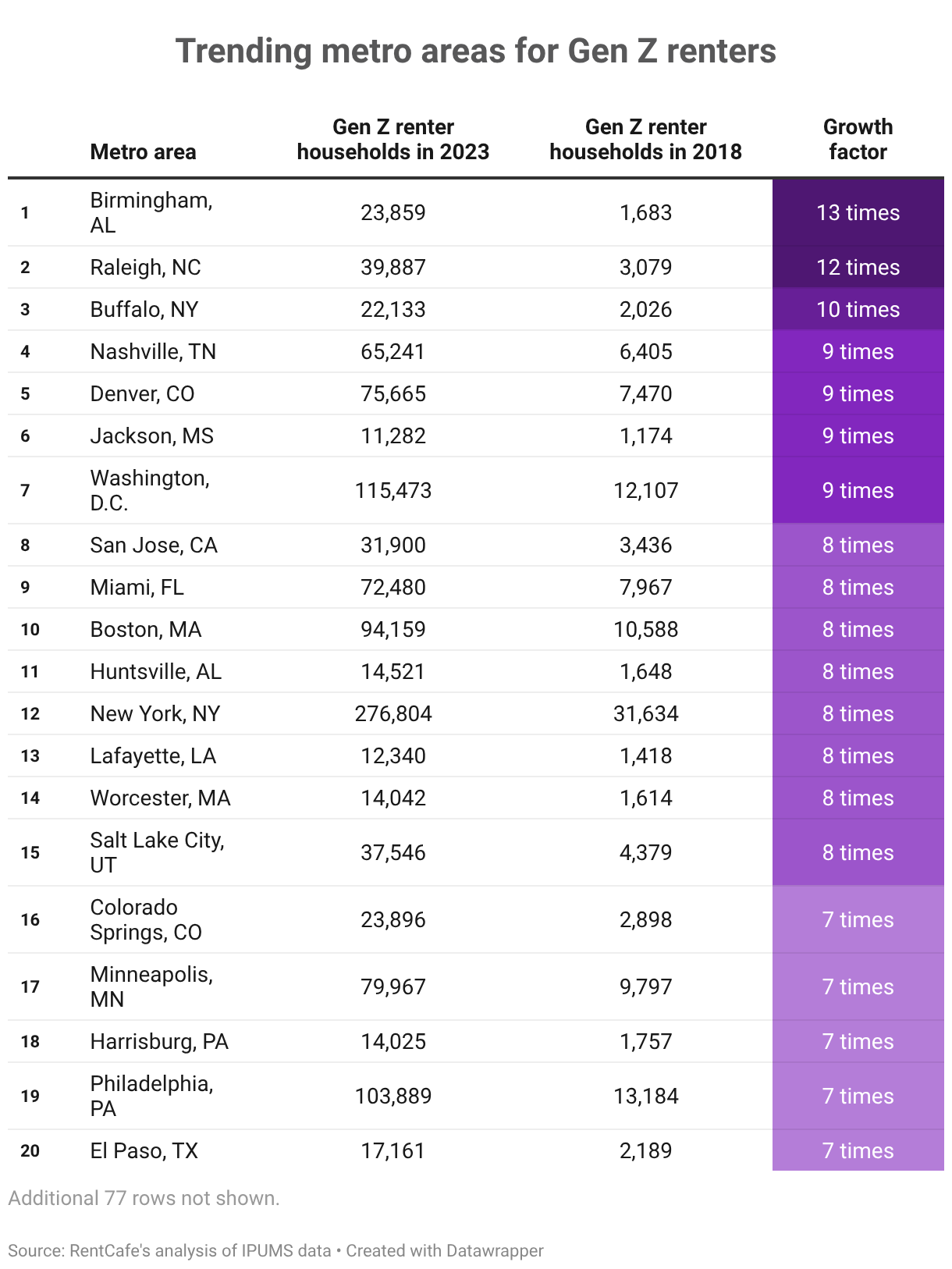
For instance, Birmingham, AL, wasn’t on anyone’s list of Gen Z hotspots five years ago. Now, it leads the nation in young renter growth with a thirteenfold increase. Following closely are two other youth-friendly metro areas in the South — Raleigh, NC, and Nashville, TN — with twelvefold and ninefold surges, respectively.
Of course, major hubs like Washington, D.C. (#7); San Jose, CA (#8); Miami (#9); Boston (#10); and Philadelphia (#19) are also on the list, attracting Gen Z renters with professional growth opportunities, as well as unique lifestyle amenities.
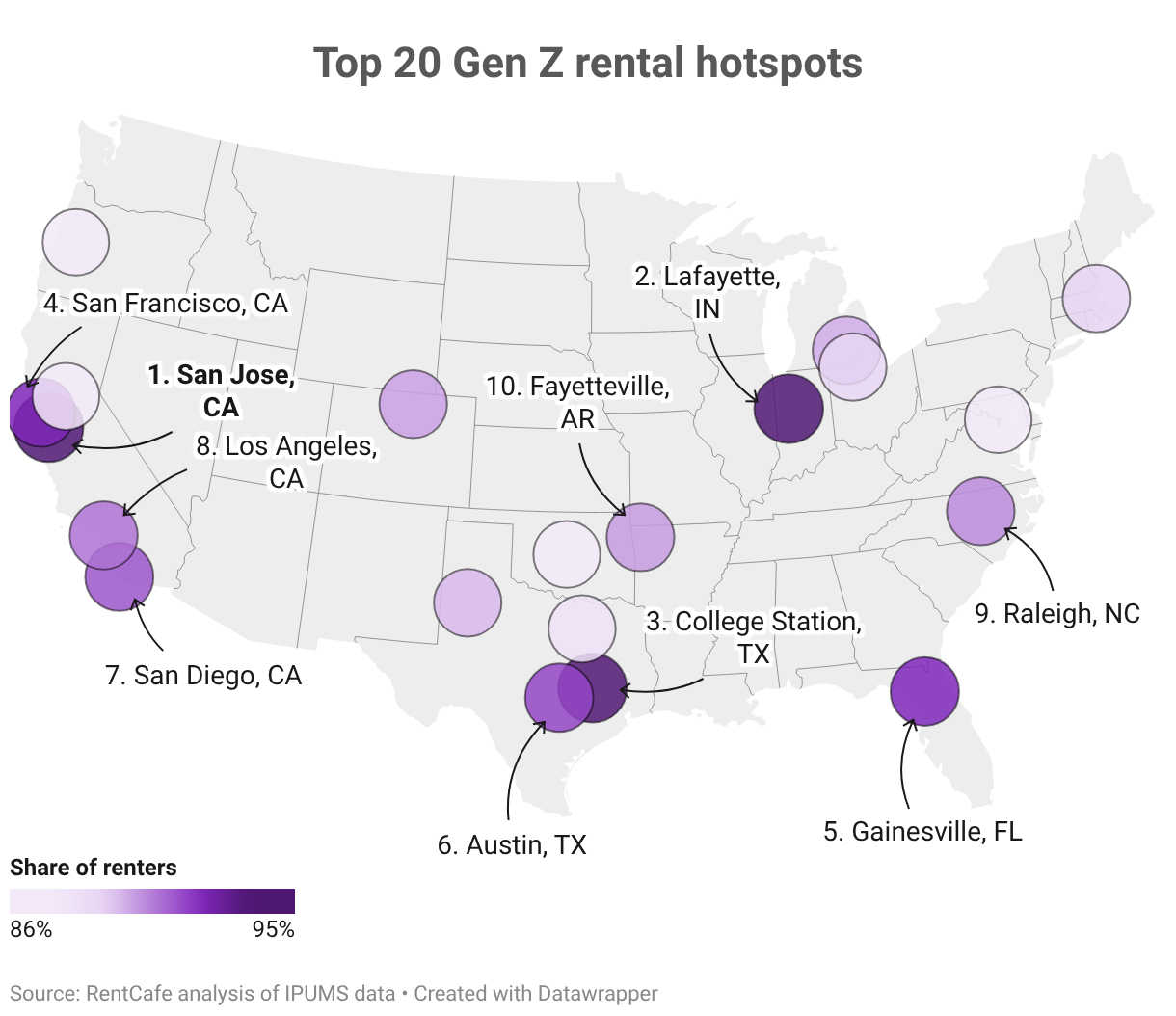
California metro areas have the highest concentrations of Gen Z renters, led by Silicon Valley’s San Jose. Here, close to 95% of all Gen Zers rent. Not far down the list we have San Francisco (#4), San Diego (#7), Los Angeles (#8) and Sacramento, CA (#17), where soaring home prices make renting more appealing for career-driven digital natives.
In fact, young professionals in San Jose and San Francisco saw some of the fastest wage growths in the nation with salaries nearly quadrupling in just five years. Even so, renting in these career accelerators remains a popular choice for many 20-somethings who value growth opportunities, convenience and flexibility.
On another note, although homeownership remains out of reach for many in this cohort, the lower mortgage rates from 2020 to 2022 fueled the first major wave of Gen Z homebuyers. But, which metro areas are seeing the fastest additions of Gen Z homeowners? First is Tucson, AZ, where the number of young adults who bought a home increased 170 times in just five years. It’s followed by Jacksonville, FL; Dayton, OH; and Omaha, NE.
Not to be outdone, Ogden, UT, ranks at the top with the densest pocket of Gen Z homeowners (41%). Further down the list are mid-sized metro areas in the South and Midwest, where affordability, job opportunities and strong income growth coexist harmoniously. We also observed this pattern among Millennial homeowners.
Coastal giants still attract Gen Z renters, but Southern metros see fastest gains
It’s clear that today’s young renters are looking for places with good schools, job opportunities and plenty of outdoor activities. And it’s not just the big coastal cities that offer these things. While major hubs like New York City and Boston still attract Gen Z renters, the real growth is happening in the South.
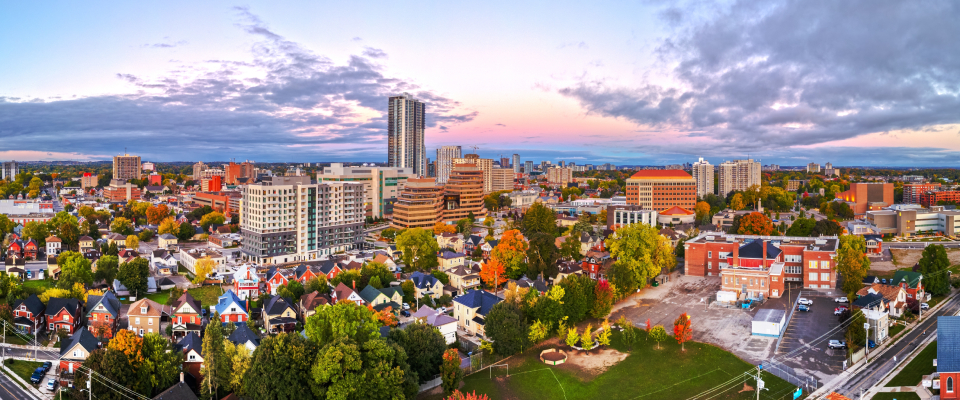
Namely, Birmingham, AL, now ranks as the metro with the fastest growth in Gen Z renters after a thirteenfold surge in just five years. While most young adults there still rent, nearly one-third already own homes — one of the highest rates in our report.
What attracts young renters to Alabama’s most populous metro area? First, it’s the lower cost of living compared to other major cities. Second, the diverse entertainment and leisure options, as well as growing business opportunities also add to its shine.
In other words, Birmingham is a “small big city” and, as such, it’s a popular choice for the youngest generation on the market along with other cities in the state. To that end, Huntsville, AL, ranks 11th on our list after the number of digital natives renting here rose eight times in five years.
Ranking second is Raleigh, NC, a college town where young renters have experienced significant income gains (299%, according to IPUMS data) in five years alongside abundant job opportunities. In Raleigh, nine out of 10 Gen Zers rent. In this case, the metro’s status as a growing tech and innovation hub helped boost its appeal among young apartment dwellers.
Meanwhile, Buffalo, NY’s affordability and appeal to remote workers (such as easy access to urban and outdoor lifestyles) have pushed the metro up to the third spot in the ranking.
Next is Nashville, TN, which saw a ninefold increase in Gen Z renters in five years. That’s no surprise given the city’s unique cultural reputation and lack of income tax.
Similarly, in Denver, the number of Gen Z renters also rose nine times in that same timeframe. Colorado’s most populous city checks many boxes for the digital native lifestyle, including a dynamic social scene; access to nature; active and health-focused living; and a strong job market.
Likewise, other Southern metros are also seeing a rapid growth in 20-something renters, including Jackson, MS, and Lafayette, LA. Both spots offer affordable living, jobs and a vibe that feels like a cool alternative to pricey coastal cities.
Which big cities are popular among Gen Z renters?
Although most of the top 20 cities gaining young renters the fastest are in the South, big cities across the country are still major draws. Take Washington, D.C., for example. The nation’s capital ranks seventh with nine times more Gen Z renter households in 2023 than in 2018.
Some of these renters are graduates of D.C.’s higher education institutions, whereas others have relocated to take advantage of jobs across the government, policy, tech, consulting and nonprofit sectors. In fact, the nation’s capital is the eighth-best metro area for Gen Z graduates thanks to its opportunities and livability. And, the tripling of the typical income for a young professional in D.C. in five years further adds to its appeal.
“Gen Z prefers renting in pricey markets like New York City and Los Angeles for the flexibility it offers, and many don’t mind smaller apartments if it means living close to everything. Social media adds to the appeal as the ‘fear of missing out’ (FOMO) makes living there feel like an important and shareable life experience.”
Adina Dragos, Writer & Research Analyst at RentCafe.com

Further down in the ranking is tech hub San Jose, CA, at #8, followed by Miami (#9) and Boston (#10). For each, the number of renters in their 20s increased eightfold as the typical income for this demographic tripled.
San Jose also stands out with the highest share of young renters (just below 95%) among all of the metro areas we considered. In each of these places, young renters can enjoy coastal living, diverse experiences and professional growth.
Occupying the 12th spot on our list, the New York metro area claims the most Gen Z renter households in the nation (close to 280,000) after an eightfold increase. And its appeal is evident — one-of-a-kind opportunities and experiences; unmatched networking; and a quadrupling in the typical Gen Z income.
Not far behind, Minneapolis (#17) and Philadelphia (#19) also rank among the top 20 metro areas with the fastest growth in this generation’s renter households, each experiencing a sevenfold increase. Another shared characteristic is that in all three metros, eight out of 10 Gen Zers are renters.
California and Texas metros are busiest Gen Z renter hotspots
If you’re a young adult renting in San Jose, CA, chances are that most of your friends are living in apartments too: Silicon Valley’s largest city has the highest concentration of 20-something renters among all of the cities we analyzed at nearly 95%.
Similarly, four other California metro areas also made our top 20 ranking for the highest shares of Gen Z renters, including San Francisco in fourth place with a 92% share and Los Angeles in eighth with almost 91%.
Yet, even as young professionals working in California metros saw their paychecks triple in five years, many potential buyers are still priced out of the local housing market. This, together with renting as a choice for convenience and flexibility, led to dense pockets of Gen Z renters.
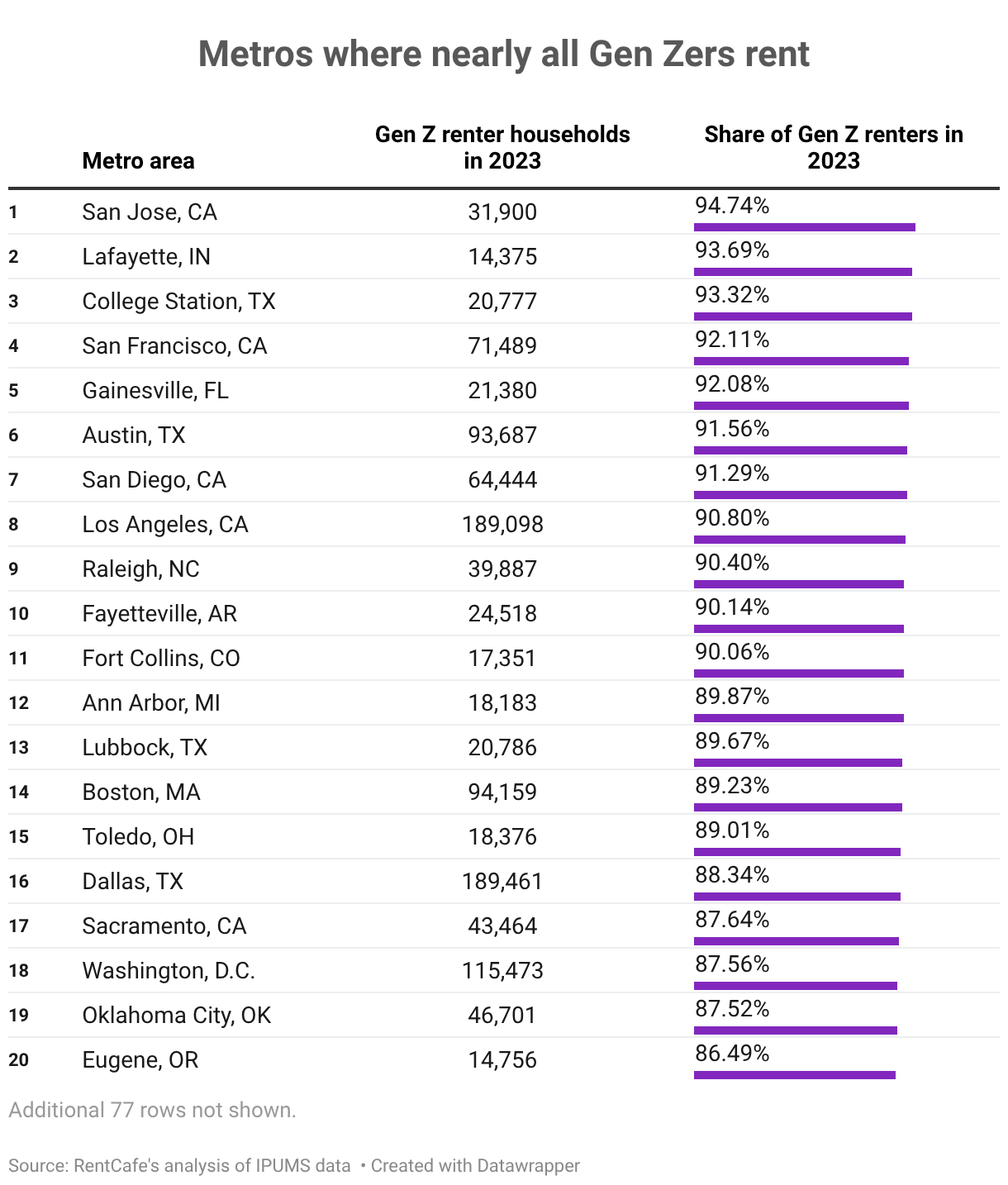
Notably, four Texas metro areas are also on the list, including College Station, TX, in third place with a 93% share and Austin, TX, in sixth place with roughly 92%. While Austin shares a similar story to California’s most popular metro areas for Gen Z renters, College Station’s solid share is based on its large population of college students as the metro is home to Texas A&M University, which has been seeing a “massive” enrollment expansion.
The runner-up is college town Lafayette, IN, where the share of Gen Z renters reached 94%. Speaking of college towns, other metros in our ranking include Raleigh, NC, and Ann Arbor, MI. In both places, nine out of 10 Gen Z households are renters.
Where did Gen Z start to buy homes?
This cohort began claiming bits of the homebuying market just a few years ago by taking advantage of lower mortgage rates. And, thus far, these youngest homebuyers have settled down in smaller and mid-sized metro areas in the South and Midwest — regions that dominate the rankings for the fastest growth in Gen Zers buying houses. That’s because these areas offer more affordable homes, as well as strong income gains: The typical income for a digital native doubled or tripled in five years in each of these places.
Furthermore, whereas some metros had fewer than 100 Gen Z owners in 2018 (when many members of this generation were too young to think about homebuying), numbers surged considerably by 2023.
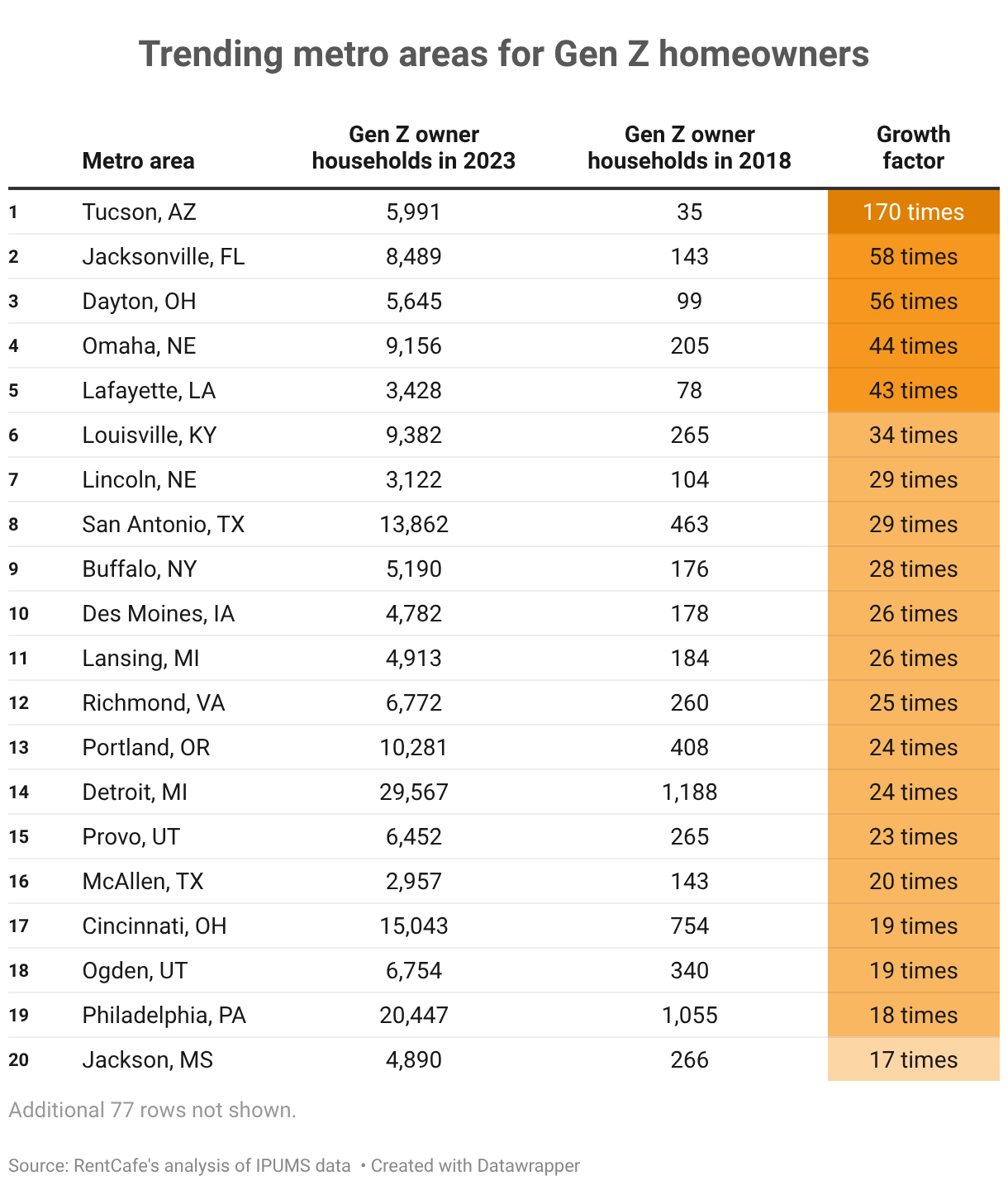
At the top sits Tucson, AZ, which counted 6,000 Gen Z owner households in 2023, which was significantly higher compared to the 35 it registered five years before. The surge is due to the convergence of several factors, including the presence of the University of Arizona; a more affordable housing market compared to Phoenix; amenities to sustain an active and social lifestyle; and, of course, strong income growth as wages more than doubled in five years.
The second- and third-fastest growing metro areas for Gen Z homeowners are Florida’s Jacksonville and Dayton, OH. In both cases, the number of households jumped about 60 times. In addition to healthy income gains (in Dayton, the average income for young professionals nearly tripled in just five years), Jacksonville and Dayton offer a cost of living below the national norm.
Furthermore, housing costs are also well below the U.S. averages in both metro areas. In this case, Jacksonville offers a more attractive alternative to Florida’s more expensive cities without compromising on opportunities and coastal living, whereas Dayton provides walkability and revitalized neighborhoods, as well as easy commutes to Cincinnati and Columbus, OH.
Fourth on the list is Omaha, NE, where the number of 20-something homeowners multiplied 44 times in five years to reach more than 9,000 households. This Midwestern metro area offers housing costs that are close to 20% below the national average, which makes it a great option for first-time homebuyers. Plus, its diverse economy and job programs for young professionals make settling down here more appealing.
Next is Lafayette, LA, which ranks fifth after claiming more than 3,400 Gen Z homeowners in 2023 compared to just 78 in 2018. That total now accounts for 22% of all young adult households in the metro area. In addition to a busy cultural events calendar and a dynamic food and music scene, Lafayette is also an affordable Southern metro for homebuyers.
Other top metro areas where Gen Z homeownership has been surging are Louisville, KY; Lincoln, NE; San Antonio; Des Moines, IA; Lansing, MI; and Buffalo, NY, as the highest-ranking Northeastern metro area.
Which metro areas have the largest concentrations of Gen Z homeowners?
For more in-depth insights into homeownership for this generation, we also looked at the highest shares of young homeowners among the 97 metro areas we analyzed. In 10 of these, more than one-quarter of Gen Zers own a home.
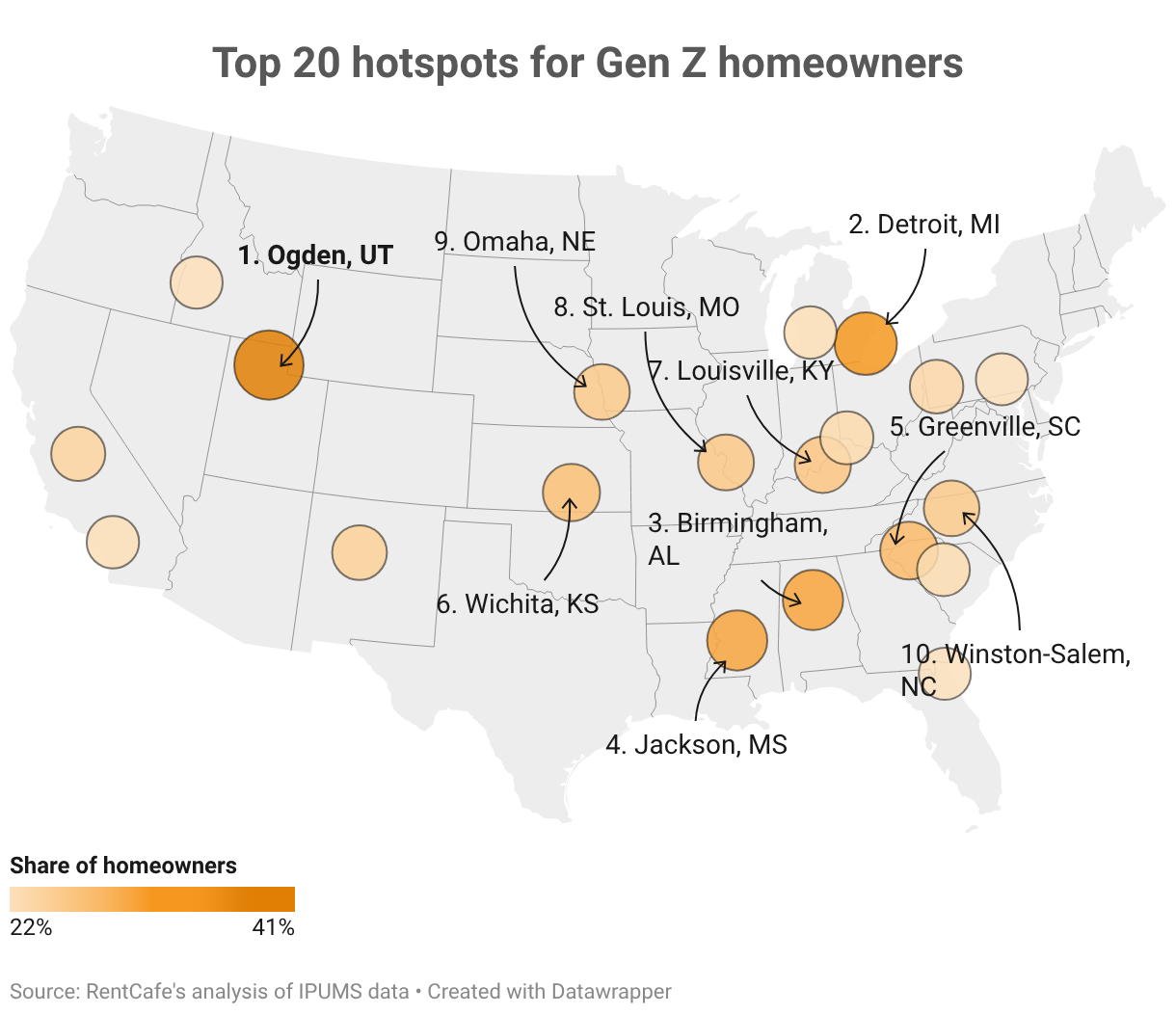
When it comes to the largest share of Gen Z homeowners, Ogden, UT, takes the lead with roughly 41%. Located north of Salt Lake City, Ogden offers a short commute to the state capital, as well as homeownership assistance programs — two great incentives for 20-somethings looking to settle down in this scenic metro area.
Following closely is Detroit, where one-third of young adults are homeowners after the number of households exceeded 29,500 in 2023 for one of the highest net numbers in our analysis.
Next are Southern metros Birmingham, AL, and Jackson, MS, each with a 30% share of homeowners within this demographic. In both places, the typical income for a young professional has more than tripled in five years, which fueled homebuying for the youngest generation in the housing market.
Then, Greenville, SC, makes an appearance with about 28% of all Gen Z households in the homeowner category.
At the opposite end of the spectrum, San Jose, CA, has the smallest share of Gen Z homeowners (5%). Almost all digital natives in this tech hub prefer renting, and affordability and flexibility are usually their main motivations.
FAQs: Gen Z housing hotspots in 2026
Q: How many Gen Z renters are in the U.S.?
A: There are 4.4 million Gen Z renter households in the U.S., which is six times more than prior to the pandemic, according to the latest research by RentCafe.com.
Q: Which areas are adding the most Gen Z renters?
A: Birmingham, AL, leads the nation with the fastest growth in Gen Z renters after a thirteenfold increase in just five years. Next are Raleigh, NC, and Buffalo, NY.
Q: What is the top metro area for Gen Z renters?
A: San Jose, CA, has the highest share of Gen Z renters at nearly 95%.
Q: Where is Gen Z buying homes?
A: Gen Z is gravitating towards smaller and mid-sized metros in the South and Midwest for buying homes. Tucson, AZ; Jacksonville, FL; and Dayton, OH, saw the biggest increases in Gen Z homeowners.
Q: What is the top metro area for Gen Z homeowners?
A: Ogden, UT, ranks highest with 41% of Gen Z households owning their homes.
Methodology
RentCafe.com is a nationwide apartment search website that enables renters to easily find apartments and houses for rent throughout the U.S.
Generation Z was defined as per Pew Research Center data (individuals born between 1997 and 2012). The ownership and rentership data, as well as Gen Z income growth, were sourced from IPUMS. Only metro areas with a Gen Z household population higher than or equal to 15,000 in 2023 were considered (97 metro areas).
IPUMS refers to Integrated Public Use Microdata Series, which provides census and survey data from around the world integrated across time and space. IPUMS is a part of the Institute for Social Research and Data Innovation at the University of Minnesota. IPUMS USA, University of Minnesota, www.ipums.org.
Steven Ruggles, Sarah Flood, Matthew Sobek, Daniel Backman, Grace Cooper, Julia A. Rivera Drew, Stephanie Richards, Renae Rodgers, Jonathan Schroeder and Kari C.W. Williams. IPUMS USA: Version 16.0 [dataset]. Minneapolis, MN: IPUMS, 2025. https://doi.org/10.18128/D010.V16.0
Job growth data was provided by the U.S. Bureau of Labor Statistics, while local inflation data was sourced from the U.S. Bureau of Economic Analysis.
Fair use and redistribution
We encourage you and freely grant you permission to reuse, host, or repost the research, graphics, and images presented in this article. When doing so, we ask that you credit our research by linking to RentCafe.com or this page, so that your readers can learn more about this project, the research behind it and its methodology. For more in-depth, customized data, please contact us at media@rentcafe.com.
Share this article:


Alexandra Both
Alexandra Both is a senior real estate writer and research analyst with RentCafe. She brings over 10 years of real estate writing experience, having served as a senior editor at Commercial Property Executive and Multi-Housing News. A seasoned journalist, Alexandra has worked across print, online, and broadcast media. Her work has been featured in a variety of prominent outlets, including The New York Times, The Guardian, USA Today, and Architectural Digest. She holds a B.A. in Journalism and an M.A. in Community Development.
Sign up for The Ready Renter newsletter
Get our free apartment hunting guide — plus tips, trends and research.




Related posts
San Diego vs. Los Angeles: Which city fits your renter budget?
Los Angeles and San Diego share a coastline, a climate and a reputation for expensive rent, but the day-to-day cost of living in each city…
Tempe, AZ on a budget: The most affordable neighborhoods to call home
Tempe is the kind of city where college-town energy meets serious career infrastructure. It’s home to Arizona State University, one of the largest universities in…

Finding an apartment for a new job: How to nail your search on a tight deadline
Landing a new job in a different city is exciting, but it comes with an immediate challenge: where are you going to live? Finding an…
Subscribe to
The Ready Renter newsletter