2025 Year-end report: It’s harder than ever to find an apartment in Manhattan, NY; Miami & Chicagoland are still red-hot
Share this article:


Apartment hunting remained intense across the U.S. this year, with Miami and Chicago leading the pack and Manhattan rising fast. Fortunately, flexibility and convenience are keeping renters in the game, even as demand for rental apartments continues to climb in the hottest rental markets of 2025.
From renters chasing big-city perks to those seeking better options in smaller locations across the country, finding a place to call home was no easy task this year — even with more than half a million new apartments added nationwide.
Key takeaways:
- The U.S. rental market stayed red-hot in 2025, reaching a Rental Competitiveness (RCI) score of 75.2, up from 74.4 last year.
- Miami once again ranks as America’s hottest rental market (RCI score 92.9), but Chicago and its suburbs are close behind, proving the Midwest’s growing appeal for apartment hunters.
- Driven by the return to in-office work, Manhattan, NY, became the fourth-hottest rental market for finding apartments this year as two-thirds of renters renewed, leaving few openings for newcomers.
- The Suburban Twin Cities is the fastest-rising rental market, followed by San Francisco.
- Among smaller metros, Fayetteville, AR, leads the pack (RCI score 92.4) with apartments leasing in just 22 days, while Port St. Lucie, FL, emerged as the top trending small renting spot this year.
For the first time, Manhattan ranks among the five hardest places to rent in the U.S., as more newcomers and returning office workers compete for limited apartments. At the same time, Miami strengthened its position as the nation’s hottest place for apartment hunting with Chicagoland close behind, while the Suburban Twin Cities and San Francisco saw the biggest jumps in rental competitiveness this year.
Among smaller locations, Fayetteville, AR, shines as the toughest renting spot, while Port St. Lucie, FL, stands out as the fastest-rising small metro of 2025.
So, where was it hardest to secure an apartment this year? To find out, RentCafe.com analyzed 139 of the largest U.S. markets, ranking them by five key measures of rental competitiveness:
- how long apartments stayed vacant
- the share of rentals that were occupied
- how many renters competed for each available unit
- the percentage of renters who renewed their leases
- the share of new apartments opened this year
Based on these key indicators, we calculated a Rental Competitiveness Index to gauge how hot the U.S. market was in 2025. The national RCI score of 75.2 shows that apartment hunting was more challenging this year — even more so than in 2024, when the RCI score was 74.4.
More renters are staying put, and that’s making the market tighter than ever despite the growing supply
Although more than half a million new apartments were built this year, the U.S. rental market shows little sign of cooling. Of the 137 metros analyzed, only about 18% softened compared to 2024.
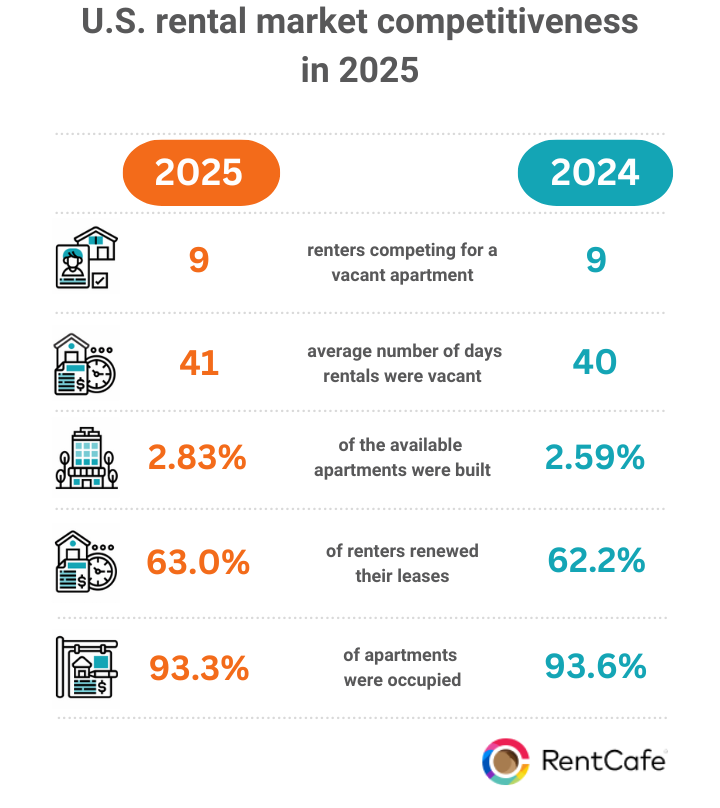
Nationwide, the number of apartments for rent grew by 2.83%, up slightly from 2.59% last year. Yet, even with more choices available, many renters chose to stay put: Lease renewals rose to 63%, up from 62.2% in 2024, driving the national occupancy rate to 93.3% and keeping competition fierce.
Likewise, vacant apartments are filled within an average of 41 days — just one day longer than last year — and each available unit still attracts about nine interested renters, showing that demand remains high across the country.
What other factors are driving rental competition across the U.S.?
Our analysis also takes a closer look at renters’ behaviors, including average length of stay, new lease terms and renewal periods.
Here’s what the data shows:
-
Renters who sign longer leases are more likely to renew for another term.
-
Across the U.S., the average renter stays in their apartment for about 28 months. Most new leases last 12 months, and renewals typically add another year on top of that.
Regionally, renters in the Northeast stay the longest — an average of 37 months, or just more than three years. In Brooklyn, NY, that figure jumps to 52 months, meaning many renters spend more than four years in the same apartment. Apartment hunters in the Northeast also sign the longest new leases, averaging 13 months, with Long Island, NY, and northern New Jersey leading at 14 months.
Renewal periods are longest in the Northeast, too. Here, they average 13 months with renters in Brooklyn and Queens extending their stays by about 15 months, on average.
Plus, more renters are staying put to avoid the stress of moving to a new place. And, with home prices and living costs still high, even would-be homeowners are choosing to rent longer, thereby keeping the apartment market as competitive as ever.
That said, the Northeast is the hottest region for renters in 2025 with an RCI score of 80.6. It’s followed closely by the Midwest (RCI score 80.3) and Florida (RCI score 79.5). Then, the South ranks fourth with an RCI score of 76.4, while the Mid-Atlantic rounds out the top five (RCI score 76.1).
California comes next with an RCI score of 74, followed by the Southeast (RCI score 72.8), Southwest (RCI score 72) and Pacific Northwest (RCI score 70.6). At the bottom of the list — though still competitive by national standards — is the West with an RCI score of 69.3.
Miami & Chicagoland top the list of hottest rental markets in 2025 with Manhattan quickly catching up
Miami once again tops the list as the most competitive rental market in the U.S., boasting the highest RCI score of 92.9.
Once known mainly as a vacation hotspot, Miami has evolved into Silicon Beach, one of the nation’s leading tech and finance hubs. As such, the transformed city has become a magnet for talent and capital from Wall Street, Silicon Valley and abroad, as well as remote workers and retirees seeking sunshine and opportunities.
This steady influx, combined with strong local demand, keeps Miami incredibly tough for securing a rental year-round. Even with a 4.22% increase in the supply of apartments this year, options remain scarce. Accordingly, nearly three-quarters of renters renewed their leases in 2025, leaving fewer than 4% of units available.
The tight supply has fueled competition in 2025 — to the point that each vacant apartment now attracts about 19 interested renters (up from 18 last year) and is typically leased within 33 days.
Between rising renewals and insufficient apartments, securing a place in Chicagoland was a real challenge this year
Chicago ranks as the second-most competitive renting spot in 2025 with a high RCI score of 88.2. Its appeal comes from a mix of big-city excitement, job opportunities, top universities and plenty of amenities — all relatively more affordable compared to coastal hubs like San Francisco or New York City.
What fueled Chicago’s heat in 2025? Here, a drop in new apartment construction — from 1.87% in 2024 to just 0.75% this year — has made finding a place tougher than ever.
So, with fewer options available, more renters decided to renew their leases, thus driving the lease renewal rate up to 61.1% from last year’s 59.2%. Consequently, the occupancy rate went from 94.5% in 2024 to 95.1% this year.
Clearly, competition for available units is fierce: Apartments in Chicago are leasing faster than they are in any other major metro, typically within 32 days, which is two days quicker than last year.
The third-hottest rental market in 2025 is Suburban Chicago, posting an RCI score of 88.1 — nearly neck and neck with the Windy City. Although renters here have a few more options this year thanks to a 1.11% bump in new supply (up from 0.71% in 2024), that’s still not nearly enough to meet demand in places like Naperville, IL; Evanston, IL; Arlington Heights, IL; or Mount Prospect, IL.
Instead, limited options have prompted more apartment-dwellers to hold onto their leases, pushing the lease renewal rate up to 70.3%, compared to 69.2% last year. Furthermore, even though the number of applicants per unit (14) and vacant days (36) have held steady since 2024, the overall occupancy rate in Suburban Chicago has inched up to 95.5%, compared to 95.4% a year earlier.
Manhattan emerges as the nation’s 4th-hottest rental market
Apartment demand is heating up in New York City, which is one of the priciest locations in the country and where most people rent rather than own. According to Point2Homes, more than 702,000 people moved to a new place in the city in 2024, and about 143,000 of them were newcomers from other states — a surge that only made competition tougher across all five boroughs.
With its finance, insurance and real estate (FIRE) sector back in full swing, Manhattan’s offices are buzzing again at pre-pandemic levels. That comeback has squeezed an already limited housing supply, pushing Manhattan to fourth place among the nation’s toughest apartment markets this year.
So, despite a modest, 0.84% increase in supply, two-thirds (66.3%) of Manhattan renters renewed, up from 64.7% in 2024. This brought the occupancy rate to 95.9%, as compared to 95.2% last year.
With so few options available, the number of applicants per vacant unit jumped from eight to 11. Apartments are also leasing much faster, now averaging 36 days on the market — down from 40 days last year.
Renters looking for apartments in New York City may have slightly better luck in Brooklyn, NY, which ranks #21 nationwide among the tightest places for renting apartments (RCI score 78.1).
One reason for this is the borough’s boost in housing supply: Apartments built this year account for 5.09% of Brooklyn’s total inventory. That growth has helped ease some of the pressure with the lease renewal rate dipping from nearly 70% in 2024 to 67.7%, giving renters a few more options to choose from.
Even so, demand remains strong: The number of applicants per available unit rose from 10 to 11 this year, showing that competition for apartments in Brooklyn remains high.
Meanwhile, rental competition in the borough of Queens, NY, is picking up steam. The borough now ranks 54th nationwide, with an RCI score of 70.7. That’s up 2.9 points from last year, bringing it close to the country’s more competitive markets.
That said, the number of people vying for each rental apartment in Queens nearly doubled, climbing from six to 10 since 2024. And, although new apartments make up 3.14% of local supply (giving renters more choice), fewer people renewed their leases (62.6% versus 69.4% in 2024). Apartments are also leasing faster — typically within 47 days, which is two days quicker than last year.
Rental competitiveness rose fastest in the Suburban Twin Cities
This year, rental competitiveness intensified in surprising corners of the country compared to 2024. Namely, the Suburban Twin Cities and San Francisco became the fastest-rising markets — while heavyweights Chicago and Manhattan also turned up the heat.
The Suburban Twin Cities’ RCI score jumped 9.2 points (from 72.9 to 82.1), marking the largest increase among all metros analyzed. The area’s appeal lies in its affordability, strong schools, shorter commutes and easy access to amenities and nature. Specifically, many renters — including those hoping to buy a home eventually — are drawn to the quieter, safer atmosphere of the suburbs compared to the urban core.
However, renting became tougher in 2025 across suburbs like Woodbury, MN; Roseville, MN; Bloomington, MN; Brooklyn Park, MN; Edina, MN; River Falls, WI; and Hudson, WI. That’s because new construction took a sharp downturn in the area. Moreover, the housing supply grew just 2.45% this year, down from 5.18% in 2024, leaving apartment hunters with far fewer choices.
As a result, more renters stayed put — 67.8% renewed their leases, up from 66.1% last year. This pushed the occupancy rate to 94.7% from 93.9% in 2024.
And, with fewer units available, competition intensified: The number of applicants per unit rose from nine to 11, and apartments are leasing faster too — typically within 38 days, which is two days quicker than last year.
The Twin Cities overall also became more competitive, ranking fifth among the nation’s top trending renting spots: The metro’s RCI score rose from 72.9 in 2024 to 78.1 in 2025, driven by a 2.8% increase in renewals (now 63%) as renters faced fewer new apartment choices across the metro.
Securing an apartment in San Francisco is tougher this year
San Francisco emerged as the second fastest-rising renting spot this year with its RCI score jumping 7.4 points, from 65.4 to 72.8. Beyond the world-class amenities, the growth in high-paying tech jobs — especially in AI — and the return to in-office work have fueled strong demand for apartments in San Francisco, intensifying competition across the metro.
Still, supply isn’t keeping up. Developers built fewer units this year, with the share of new apartments dropping from 3.11% to just 1.43%. So, lease renewals edged up to nearly 50%, and the occupancy rate rose from 93.3% to 94.6%, leaving renters with fewer choices. As a result, the number of applicants per available unit jumped from seven to 11 in just one year.
It’s also worth noting that two of the nation’s toughest places for those looking to secure a new home — Chicago and Manhattan — have become even hotter in 2025. Specifically, Chicago’s apartment market sizzled throughout the year, with its RCI score jumping 5.7 points to 88.2, fueled by rising lease renewals and fewer available rentals.
At the same time, New York City’s rebound has been led by Manhattan, which now ranks at #4 among the top trending rental markets. Its RCI score rose 5.6 points to 84.5 in the last 12 months as limited new construction, higher renewal rates and dwindling options made securing an apartment more challenging than ever.
2026 outlook: More competition in peak season, but incoming new apartments may give renters some breathing room
The apartment market is expected to stay fairly competitive in 2026, especially during the busy summer months. While the year will likely begin on a calmer note, conditions are set to tighten quickly as demand rises and available apartments become harder to find.
The seasonal imbalance between supply and demand will follow a familiar pattern. But, this time, competition could be even tougher. By early summer, the number of renters per available unit is expected to reach 11 — the highest level in recent years.
Around the same time, a wave of new apartments is set to hit the market, adding about 1.29% to the nation’s housing supply. But, that boost won’t last long: New construction is projected to fall sharply to just 0.47% by year’s end.
What’s more, even with more apartments coming online, renters will need to act fast. Early in the year, units may stay vacant for about 51 days, on average, giving apartment hunters a short window to find deals or rent specials. Then, by the end of 2026, apartments could be leasing in as few as 30 days as supply slows and demand stays high.
Similarly, occupancy rates are expected to hover between 93.5% and 93.8%, reflecting strong demand throughout the year. And, lease renewals will likely start around 62.2% and dip slightly to 61.8% by December — meaning most renters will stay put, either for convenience or due to the high costs associated with moving to a new place.
Apartments lease fastest in Fayetteville, AR, the nation’s hottest small metro for renters this year
Notably, smaller, more affordable areas across the U.S. (where housing options are limited and living costs are lower) are also very tough renting spots. This year, the Midwest dominates the list of most competitive small metros, claiming six of the top 20 spots, followed by the Northeast with five.
That said, the South’s Fayetteville, AR, stands out as 2025’s hottest place for apartment hunters, boasting a high RCI score of 92.4, which is up 3.7 points from last year. Despite a solid 3.03% increase in rental units, demand here still far exceeds new construction. On average, apartments in Fayetteville are leased in just 22 days — the fastest in the country — while vacancy rates remain below 4%.
And, with 73% of renters staying put, largely due to limited options, competition is fierce: Each vacant unit now draws 12 applicants, up from 11 a year ago.
This extraordinary demand even prompted officials to declare a housing crisis in early 2024 as growth continues to outpace development. In this case, a 28% population surge in the last decade — fueled by record enrollment at the University of Arkansas, job creation from Walmart, and high interest rates that make homebuying less accessible for locals — has only tightened Fayetteville’s apartment market in recent years.
Apartment hunters are also feeling the heat in Lehigh Valley, PA, which ranks as the nation’s second-most-competitive small metro in 2025 (RCI score 90.6). Even with a 2.58% bump in supply (up from 2.44% in 2024), securing an apartment here is no easy task. Demand continues to surge — especially in places like Bethlehem, PA; Allentown, PA; and Easton, PA — as commuters, remote workers and newcomers from New Jersey and New York search for more affordable options.
Adding to the pressure, local colleges — such as Lehigh University and Northampton Community College — continue to draw students, and campus housing is often packed. As such, many end up renting off-campus, competing with young professionals and families for budget-friendly apartments.
With supply this tight, nearly 80% of renters renewed their leases (just below last year’s 80.7%), to keep occupancy high at 96.2%. On average, apartments are filled within 40 days, and each one attracts about 15 applicants — the highest number among the small metros analyzed.
Not far away, Harrisburg, PA, ranks #3 nationwide with an RCI score of 88.2. Its surge in white-collar jobs and remote work opportunities has drawn new residents from Philadelphia and elsewhere, pushing rental demand beyond what the local housing stock can handle — even after a 1.15% supply increase (down from 1.63% in 2024).
So, more renters are staying put: 77% renewed this year (up from 75% last year), leaving just 4% of units available. With that, it now takes about 41 days to lease an apartment, and each vacant unit attracts 13 applicants.
It’s getting tougher to secure an apartment in Port St. Lucie, FL, the fastest-rising place for renting apartments
With fewer new apartments and more renters staying put, several Sunbelt locations have become increasingly competitive this year. Among them, Port St. Lucie, FL, (#6 nationwide) stands out as the top-trending market for apartment seekers after posting the biggest jump in its RCI score — up 12.5 points in the past year to go from 74.4 to 86.9.
That jump comes mostly from a steep drop in the share of new apartments, which fell from 12.86% in 2024 to just 2.63%. Plus, Port St. Lucie’s population keeps booming, driven by retirees, remote workers, and renters priced out of south Florida, all of whom are fueling stronger demand for a limited pool of apartments.
As such, lease renewals shot up from 69.8% to 75.1% in 2025, keeping occupancy high at 95.6%. On average, vacant apartments in Port St. Lucie are rented within 37 days (one day faster than last year) and each one sees competition from 12 applicants, showing just how tight the market has become.
Ranking #2 among the nation’s fastest-rising small metro for renters in 2025 is Lubbock, TX, where the RCI score jumped 8.2 points to 82.4. This surge in competitiveness comes down to Lubbock’s growing economy and — most notably — Texas Tech University, whose record enrollment flooded the apartment market with students this year.
In fact, competition for apartments in Lubbock has more than doubled since last year with 11 renters now vying for each available unit, up from five in 2024. On top of that, apartments are leased in just 34 days, on average, which is one day faster than last year. Despite a 1.8% increase in housing supply (nearly double 2024’s 0.92%), it’s still not enough to meet soaring demand.
With inventory this tight, more renters are choosing to stay put — 60.9%, up from 60.1% last year — pushing occupancy to 94.2% in a big jump from 91.8% in 2024.
Browse the maps below to see each region’s rental competitiveness in 2025:
FAQ
Q: What’s the hottest rental market in 2025?
A: Miami holds onto its #1 spot with but Chicago and its suburbs are close behind. Manhattan, NY, is also catching up fast as limited options keeps competition fierce.
Q: Which U.S. region is most competitive for renters this year?
A: The Northeast tops the list as the toughest region for securing an apartment, followed by the Midwest and Florida.
Q: What are the top trending metros for apartment hunters in 2025?
A: The Suburban Twin Cities area saw the biggest jump in competitiveness. Finding an apartment in San Francisco also got tougher this year.
Q: What’s the most competitive small rental market this year?
A: Fayetteville, AR, ranks as the hottest small metro for apartment hunters.
Q: Which are the fastest-rising small metros for finding apartments in 2025?
A: Port St. Lucie, FL, and Lubbock, TX, emerged as the top trending small metros for renters this year.
Q: What can apartment hunters expect in 2026?
A: Finding an apartment could get tougher in peak rental season, but a wave of new units in the summer should make the search a little easier.
Methodology
To compile this report, RentCafe.com’s research team analyzed Yardi Systems apartment data across 139 rental markets in the U.S. The data comes directly from market-rate, large-scale, multifamily properties of at least 50 units. Fully affordable multifamily properties were excluded.
The markets were ranked based on a market competitive score. To calculate each market’s score, we ranked them according to five metrics and their averages for January through September 2025. These metrics include: apartment occupancy rate; average total days vacant; prospective renters per vacant unit; renewal lease rate; and share of new apartments completed during the same timeframe.
We then compiled an average ranking by assigning a percentage weight for each metric: 30% for apartment occupancy rate; 15% for average vacant days; 15% for prospective renters per vacant unit; 30% for renewal lease rate; and 10% for the share of new apartments.
In this study, the terms “market,” “area,” “metro,” and “location” are used interchangeably and are as defined by Yardi Matrix markets.
Fair use and redistribution
We encourage you and freely grant you permission to reuse, host, or repost the research, graphics, and images presented in this article. When doing so, we ask that you credit our research by linking to RentCafe.com or this page, so that your readers can learn more about this project, the research behind it and its methodology. For more in-depth, customized data, please contact us at media@rentcafe.com.
Share this article:


Veronica Grecu
Veronica Grecu is a senior creative writer and research analyst for RentCafe. With more than 14 years of experience in the real estate industry, she covers a variety of topics in the apartment market, including rental competitiveness, new construction and other industry trends. Her work has been featured in top publications like The New York Times, The Washington Post, The Wall Street Journal, The Philadelphia Inquirer, The Miami Herald, CNN, CNBC, and more. Prior to RentCafe, Veronica was involved in producing real estate content for Multi-Housing News, Commercial Property Executive and Yardi Matrix. She holds a B.A. in Applied Modern Languages and an M.A. in Advertising and PR.
Sign up for The Ready Renter newsletter
Get our free apartment hunting guide — plus tips, trends and research.




Related posts

RentCafe Internet connects you to high-speed WiFi and entertainment services in one place
RentCafe partners with leading internet providers to bring reliable internet, streaming and mobile options directly to renters. Applicants and residents can browse and activate available…
How to break a lease without wrecking your finances or your record
Life changes fast. A new job across the country, a growing family, or an unexpected health situation can all make your current apartment feel like…

From dorm to lease: A step-by-step guide to the first apartment rental process
The first apartment rental process is your transition from shared dorm living to renting a place that’s fully yours. It involves setting a realistic budget,…
Subscribe to
The Ready Renter newsletter