Record year for affordable housing construction — Seattle leads the nation
Share this article:


In the past five years, the U.S. built nearly 310,000 new affordable apartments, according to sister company Yardi Matrix* — an unprecedented surge, with nearly one-third of that total delivered in 2024. Affordable housing construction rose 73% compared to the previous five-year period (2015–2019), far outpacing the 36% growth in overall apartment construction.
To better understand where this growth is happening, we analyzed affordable housing construction over the last 10 years. While large coastal markets like Seattle and New York saw major output, fast-growing locations like Austin and San Antonio — where completed apartments more than doubled — also emerged as key contributors to the country’s affordable housing pipeline.
*Data extracted in early 2025.
Key takeaways:
- Nearly 310,000 affordable apartments have been built nationwide since 2020, accounting for 12.6% of all new apartment buildings.
- 2024 alone delivered 91,000 affordable units — nearly a third of the five-year total.
- Affordable housing construction rose 73% compared to 2015–2019, outpacing overall apartment building growth.
- San Antonio, Phoenix, and Charlotte recorded the fastest growth in affordable housing for renters among major U.S. metros.
More than 91,000 affordable apartments were completed in 2024 alone — the highest annual total in the past decade. That figure stands out not only for its scale, but also for how sharply it departs from previous years. The surge made 2024 the single largest yearly contribution to affordable housing construction in ten years, setting it apart as a defining moment in the recent building cycle.
Affordable housing in this context refers to apartment buildings where all units are income-restricted. That means rents are set so they stay affordable for households earning up to a certain percentage of the local Area Median Income (AMI), typically in exchange for public subsidies or tax credits. These developments are designed to serve lower- and middle-income renters and often remain affordable for decades.
Notably, affordable housing is starting to make up a larger portion of all new apartment construction. In 2024, nearly 14% of all new apartments were income-restricted — up from just under 9% ten years earlier — indicating a growing emphasis on affordability in new development.
The American Rescue Plan has helped move things forward by directing billions of dollars into housing through State and Local Fiscal Recovery Funds. On top of that, many states introduced or expanded their own tax credit programs. These efforts helped developers cover rising costs and move projects across the finish line faster while simultaneously keeping rents affordable for the long term.
Between the two five-year periods (spanning 2015 to 2019 and 2020 to 2024), the U.S. saw a dramatic increase in the completion of affordable apartments: The number of apartments for lower-income renters delivered nationwide surged by 73%, rising from approximately 179,000 in the first half of the 10-year period to nearly 310,000 in the latter.
The nationwide growth in affordable housing construction between 2020 and 2024 was driven in large part by expanded public funding and policy support. At the federal level, the Low-Income Housing Tax Credit (LIHTC) continues to play a central role in getting projects built. Additionally, a key update —in the form of income averaging — gave developers more flexibility by allowing a wider range of income levels across units, while still meeting affordability requirements.
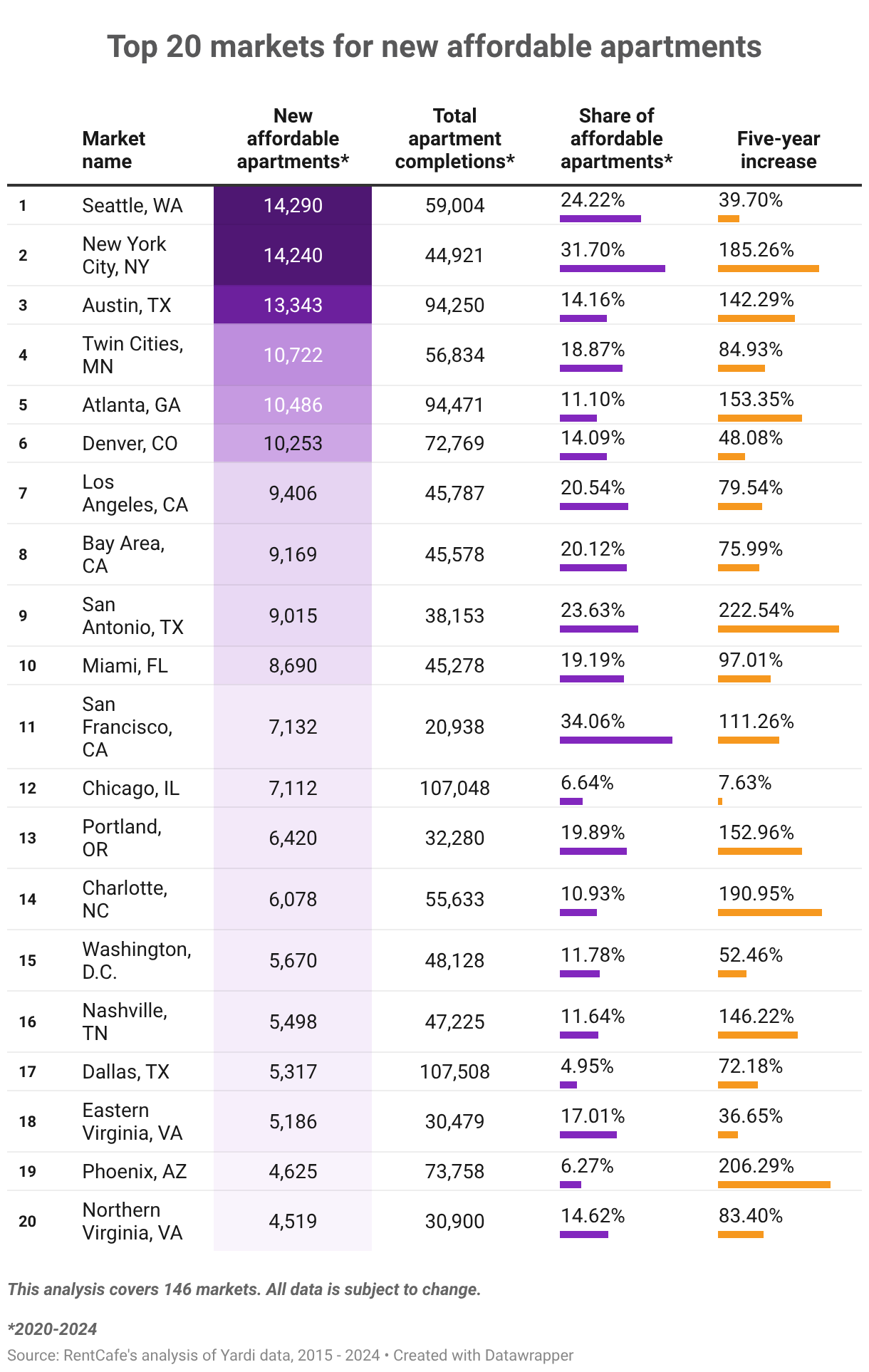
Seattle tops U.S. metros in affordable housing construction in last 5 years
1. Seattle
- New affordable apartments (last 5 years): 14,290
- Share of new affordable apartments: 24.22%
- Five-year increase: 39.7%
Seattle is the nation’s leader in affordable housing construction with more than 14,000 affordable apartments completed in the last five years. This marks an increase of nearly 40% compared to the previous five-year period, when just more than 10,000 such units were delivered. Affordable housing for renters accounted for one-quarter of the metro’s total of 59,000 new apartment buildings during this time.
A key contributor to this surge is Four Corners, a 430-unit development located at 8102 Evergreen Way in Everett, WA. Backed by a $1 million grant from the Connecting Housing to Infrastructure Program (CHIP), the project stands out not only for its scale, but for extending affordable housing beyond Seattle’s limits into Snohomish County.
2. New York City
- New affordable apartments (last 5 years): 14,240
- Share of new affordable apartments: 31.70%
- Five-year increase: 185.26%
New York City has seen one of the most substantial surges in the construction of affordable housing for renters, completing 14,240 such units since 2020 — a whopping 185% increase compared to the previous five years. During this timeframe, affordable units accounted for 32% of all new housing deliveries locally.
One of the largest recent examples is the 669-unit property at 2926 W. 19th St. in Brooklyn near Coney Island. Projects of this size illustrate how recent policy and investment efforts are translating into visible changes across New York’s housing landscape.
3. Austin, TX
- New affordable apartments (last 5 years): 13,343
- Share of new affordable apartments: 14.16%
- Five-year increase: 142.29%
Austin more than doubled its output of affordable apartments, delivering over 13,300 new units during a period of intense population growth and mounting housing demand. Despite this increase, affordable apartments made up just 14% of the total new housing supply in the area.
A standout project is High Point Preserve, a 454-unit affordable community at 9301 E. U.S. Highway 290. Located in East Austin — one of the metro’s fastest-changing areas — the project helps expand affordable housing options for renters amid ongoing cost increases.
4. Twin Cities: Minneapolis & St. Paul, MN
- New affordable apartments (last 5 years): 10,722
- Share of new affordable apartments: 18.87%
- Five-year increase: 84.93%
The Twin Cities completed 10,722 affordable apartments since 2020 — an increase of nearly 85% versus the previous five-year period. These units accounted for almost 19% of all new housing deliveries during this time. That growth shows how the metro is stepping up efforts to build more housing that working families can actually afford.
Here, Bren Road Station — a 260-unit community situated at 11001 Bren Road E. in Minnetonka — is an important development in the region. The project adds new affordable housing to Minnetonka — a suburb where development has often leaned toward higher-end projects, making options at lower price points less common.
5. Atlanta
- New affordable apartments (last 5 years): 10,486
- Share of new affordable apartments: 11.10%
- Five-year increase: 153.35%
Atlanta completed nearly 10,500 affordable apartments in the last five years. Although that’s a remarkable 153% increase compared to the previous five years, these affordable units comprised just 11% of all new housing completed locally during that timeframe.
Among the area’s major developments in affordable housing for renters is the Reserve at Douglasville, which brought 286 apartments for lower-income renters to 7755 Dallas Highway 92. Set in a growing suburb west of Atlanta, the property introduces affordable apartments to an area where new housing has often skewed toward higher price points.
6. Denver
- New affordable apartments (last 5 years): 10,253
- Share of new affordable apartments: 14.09%
- Five-year increase: 48.08%
Denver added over 10,250 affordable apartments since 2020 to mark a 48% increase in affordable housing construction compared to the number of apartments built during the previous five years. These additions made up 14% of the metro’s total housing output during this time — a significant share for a market facing sustained affordability challenges and rapid population growth.
A highlight among recent builds is Larkridge, a 338-unit affordable housing community located at 16105 Washington St. in Thornton, CO. The property helps address affordability in one of the metro’s fastest-growing suburbs, thereby relieving demand for affordable housing in Denver’s fast-growing northern suburbs.
7. Los Angeles
- New affordable apartments (last 5 years): 9,406
- Share of new affordable apartments: 20.54%
- Five-year increase: 79.54%
Los Angeles delivered over 9,400 affordable apartments in the last five years — an increase of nearly 80% from 2015 to 2019 — making up more than 20% of all new apartment buildings in the area. That growth comes amid rising rents and home prices in one of the most cost-burdened housing markets in the country.
Among the metro’s most noteworthy recent developments is Florence, a 600-unit community spanning two addresses: 1600 E. Florence Ave. and 1650 W. Florence Ave. This large-scale project brings much-needed affordable housing to south Los Angeles, a historically underserved area.
8. Bay Area, CA
- New affordable apartments (last 5 years): 9,169
- Share of new affordable apartments: 20.12%
- Five-year increase: 75.99%
The Bay Area saw the completion of 9,169 affordable apartments since 2020 — a 76% increase compared to the five years prior. These made up roughly 20% of total housing deliveries in the region.
Antioch, a 390-unit development located at 3560 E. 18th St., is a notable affordable housing development that was completed recently. Situated in Antioch — one of the few remaining pockets of relative affordability in the Bay Area.
9. San Antonio
- New affordable apartments (last 5 years): 9,015
- Share of new affordable apartments: 23.63%
- Five-year increase: 222.54%
San Antonio experienced the fastest growth in affordable housing construction nationwide, completing over 9,000 affordable apartments — a whopping 223% increase compared to the previous five years. These units accounted for nearly one-quarter of all housing built in the area from 2020 to 2024.
One of the metro’s most significant developments is Kallison Ranch, a 384-unit property located at 8212 Talley Road. This project adds critical housing supply on the rapidly growing far west side of San Antonio.
10. Miami
- New affordable apartments (last 5 years): 8,690
- Share of new affordable apartments: 19.19%
- Five-year increase: 97.01%
Miami completed 8,690 affordable apartments from 2020 to 2024, which is an increase of 97% compared to the previous five years. These units accounted for 19% of all new housing built.
A standout development is Residences at Sawyer’s Walk, a 578-unit affordable community located at 249 NW Sixth St. The property sits in the heart of Overtown and contributes to broader efforts to preserve affordability in one of Miami’s most historic neighborhoods — especially as the metro has consistently ranked as the most competitive rental market in the country.
San Antonio sees fastest growth in affordable housing construction
In 16 of the top 20 metros in our ranking, construction of affordable apartments increased by more than 50% from 2020 to 2024 compared to 2015 to 2019. That said, several U.S. metros have experienced rapid growth in the construction of affordable apartments for renters in the past five years, with San Antonio leading the pack: The metro saw a 223% increase in completed apartments from the previous period, adding more than 9,000 new units between 2020 and 2024.
Phoenix followed with a 206% surge, while Charlotte, NC’s affordable housing output grew by 191%. Not to be outdone, New York City (already a major builder of affordable units), saw a significant 185% increase, totaling more than 14,000 units built — the highest volume among the five.
Markets experiencing fastest growth in affordable apartment construction
This analysis covers 146 markets. All data is subject to change.
Other fast-growing markets also reflected this shift: Atlanta and Portland, OR, each saw 153% increases in deliveries, adding more than 10,000 and 6,400 units, respectively. Next, Nashville, TN, followed with a 146% uptick, delivering nearly 5,500 new affordable apartments. Then, Austin, TX — another high-growth metro — witnessed a 142% increase with more than 13,000 units completed.
Finally, San Francisco experienced a 111% rise in completed apartments, contributing more than 7,000 apartments for lower-income renters — a notable figure for a location historically constrained by high land costs and stringent permitting processes.
FAQs: Affordable housing construction 2026
Q: How many affordable apartments were completed in 2024?
A: More than 91,000 affordable apartments were built in 2024 — the highest annual total in the past decade and nearly a third of all affordable units added in the last five years.
Q: What share of all new apartments were affordable in 2024?
A: Affordable apartments accounted for nearly 14% of all new apartment completions, up from 9% nearly 10 years earlier.
Q: How much has affordable housing construction grown compared to overall apartment construction?
A: Between 2020 and 2024, affordable apartment construction grew by 73%, far outpacing the 36% growth in overall apartment building activity during the same period.
Q: Which metros added the most affordable apartments?
A: Seattle led the way with nearly 14,300 new affordable apartments, followed closely by New York City (14,240), the Twin Cities (10,722), and Austin (13,343).
Q: What policies or funding helped drive this increase of affordable housing construction?
A: Key drivers included the Low-Income Housing Tax Credit, the American Rescue Plan, and new or expanded state tax credit programs.
Methodology
RentCafe.com is a nationwide apartment search website that enables renters to easily find apartments and houses for rent throughout the United States. This report was compiled by the RentCafe.com research team based on apartment data provided by our sister company, Yardi Matrix. This analysis covers 146 markets. All data is subject to change.
For this report, “fully affordable” refers to residential buildings in which all units are income-restricted. Meaning, for each unit designated as affordable, rent does not exceed 30% of the income limit tied to the applicable Area Median Income (AMI), such as:
- 30% AMI – extremely low income
- 50% AMI – very low income
- 60% AMI – LIHTC typical level
- 80% AMI – moderate income
etc.
These buildings are typically operated by local housing authorities or nonprofit organizations and are designed to provide long-term affordability.
We excluded partially affordable developments — properties that include a mix of income-restricted and market-rate units in the same complex. In many of these buildings, the affordable units are only price-restricted for a limited period, often 10-20 years, after which they may convert to market rates.
To track growth over time, we split the 10-year period into two distinct phases: 2015-2019 (pre-pandemic) and 2020-2024 (post-pandemic).
Yardi Matrix defines completed buildings as those that have received a certification of occupancy.
*Data was extracted in early 2025.
In this study, the terms “market,” “area,” “metro” and “location” are used interchangeably and are as defined by Yardi Matrix markets.
Fair use and redistribution
We encourage you and freely grant you permission to reuse, host, or repost the research, graphics, and images presented in this article. When doing so, we ask that you credit our research by linking to RentCafe.com or this page, so that your readers can learn more about this project, the research behind it and its methodology. For more in-depth, customized data, please contact us at media@rentcafe.com.
Share this article:


Florin Petrut
Florin Petrut is a real estate writer and research analyst with RentCafe, using his experience as a social media specialist and love for storytelling to create insightful reports and studies on the rental market. With a strong interest in the renter experience, he develops data-driven resources that explore cost of living, affordable neighborhoods, and housing trends, helping renters make informed decisions about where and how they live. Florin holds a B.A. in Journalism and an M.A. in Digital Media and Game Studies.
Sign up for The Ready Renter newsletter
Get our free apartment hunting guide — plus tips, trends and research.




Related posts

RentCafe Internet connects you to high-speed WiFi and entertainment services in one place
RentCafe partners with leading internet providers to bring reliable internet, streaming and mobile options directly to renters. Applicants and residents can browse and activate available…
How to break a lease without wrecking your finances or your record
Life changes fast. A new job across the country, a growing family, or an unexpected health situation can all make your current apartment feel like…

From dorm to lease: A step-by-step guide to the first apartment rental process
The first apartment rental process is your transition from shared dorm living to renting a place that’s fully yours. It involves setting a realistic budget,…
Subscribe to
The Ready Renter newsletter