High Demand Pushes Rental Market to New Heights, Affordability Deteriorates
Share this article:


The country’s rental market is booming, with an increase in rental households, rising rents, and low vacancy levels recorded in most metros across the U.S. Average rent hit a record high of $1,150 in June 2015, up 2.9% over the past three months. The average year-over-year rent growth now stands at 6.3%, Yardi Matrix data shows.
This points to a sound real estate sector and may be good news in terms of investment opportunities and economic growth, but what does it mean for the country’s lower- and middle-income renters? Confronted with tough competition and a limited inventory of available units, financially-struggling renters find it difficult to locate affordable apartments or houses for rent, especially in regions where salaries are not keeping up with rent growth.
A recent report from NYU Furman Center and Capital One looked at the central cities of the 11 largest metropolitan areas in the U.S. (by population) from 2006 to 2013: Atlanta, Boston, Chicago, Dallas, Houston, Los Angeles, Miami, New York City, Philadelphia, San Francisco, and Washington, DC. It found that incomes stayed well behind rents in five of these, with two of the country’s biggest rental markets that most appeal to young adults – Los Angeles and New York City – faring the worst.
In all 11 cities, an overwhelming majority of low-income renters were severely rent-burdened, facing rents and utility costs equal to at least half of their income. However, the picture is rosier in cities such as Chicago, Houston, and Boston where income growth outpaced rent spikes, with Boston in particular showing substantial gains.
Renter Population Growing, Inventory Lagging Behind Demand
While all 11 cities surveyed saw a rental housing stock expansion between 2006 and 2013, it generally wasn’t enough to match the increase in renter population numbers. The only exception was Atlanta where the rental stock grew by 16% whereas the population of renters rose 7%.
Nine out of the 11 cities saw double-digit growth in the number of renters, and five of those cities saw growth exceeding 20 percent. The biggest disparity between demand and supply was recorded in Philadelphia where the population of renters grew nearly twice as much (28%) as the number of rental units (15%).
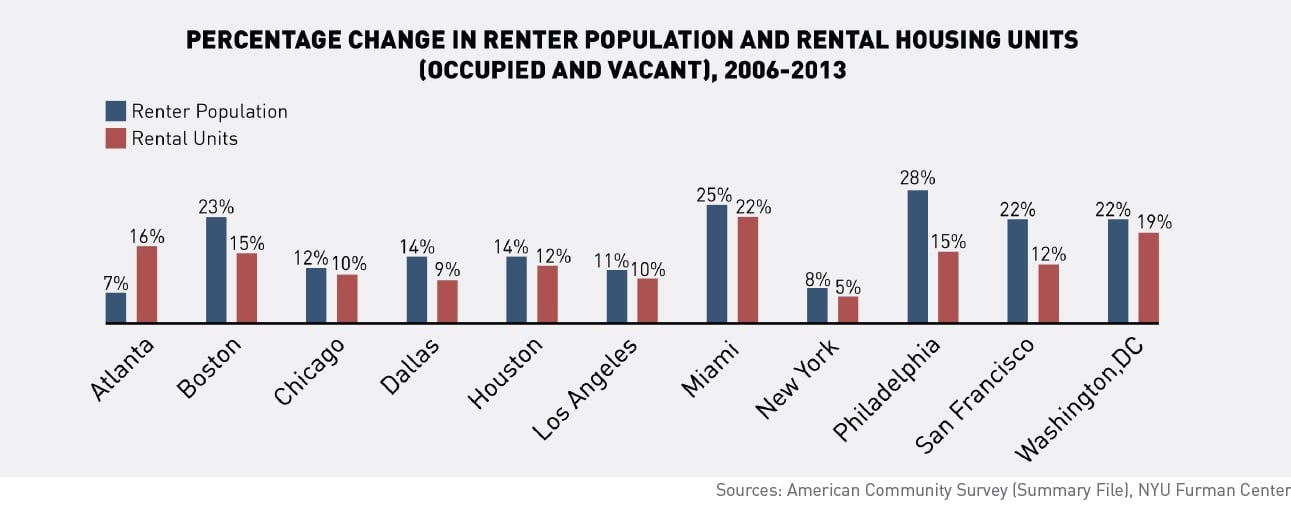
To get a better idea about the national affordable rental housing landscape, check out the cool infographic below.

Infographic via NYU Furman/Capital One
Share this article:


Amalia Otet
Amalia Otet leads publishing and content for Yardi products, where she turns real estate data and market trends into stories that inform and inspire. Outside of work, Amalia strives to live beautifully - one green step at a time.
Sign up for The Ready Renter newsletter
Get our free apartment hunting guide — plus tips, trends and research.




Related posts
Millionaire renters more than triple in 5 years, nearly half are Millennials
The number of millionaire renter households in the U.S. grew 229% between 2020 and 2024, more than tripling in just five years. While New York…
Detroit vs Chicago: Which Midwest city is more affordable for renters?
Detroit and Chicago are about 280 miles apart, making a move between the two a realistic option for many Midwestern renters. Maybe you’ve landed a…
Public transit options for renters in Newark, NJ: How to get around without a car
Newark renters can live car-free using PATH, NJ Transit rail, the Newark Light Rail and an extensive bus network, with Manhattan reachable in about 20…
Subscribe to
The Ready Renter newsletter