Share this article:


Searching for an apartment in Phoenix means thinking beyond square footage and floor plans. One of the biggest things you need to consider is how you’ll get around.
Whether you’re new to the Valley of the Sun or exploring a car-free lifestyle for the first time, Phoenix’s growing transit network can shape where you live and how you experience the city.
Here are the top Phoenix public transit options for renters considering a car-free lifestyle:
- Valley Metro Bus
- Valley Metro Light Rail
- Valley Metro Streetcar (S Line)
- Dial-a-Ride Paratransit
Phoenix is a sprawling metro area that stretches across more than 500 square miles of Maricopa County, connecting cities like Tempe, Mesa and Scottsdale into one continuous urban landscape. That scale makes reliable public transit especially valuable for renters who want to skip the costs of car ownership from gas and insurance to parking fees.
This guide breaks down each transit option, explains who it serves best and highlights the neighborhoods where transit access can make your daily commute simpler.
Top Phoenix public transport options for renters
Valley Metro Bus
Valley Metro Bus is the main form of public transportation in the Phoenix metropolitan area. Operated by the Valley Metro Regional Public Transportation Authority, the bus system covers a service area of 525 square miles across Maricopa County. That includes over 100 routes, with local, express, RAPID and community circulator services.

Why renters rely on Valley Metro Bus:
- The network spans the entire metro area, reaching neighborhoods that light rail doesn’t serve, from north Phoenix to Chandler and beyond.
- Bus stops are located within walking distance of thousands of apartment communities across the Valley, making door-to-commute connections convenient.
- Routes connect riders to major employment centers, hospitals, schools and shopping destinations throughout Phoenix, Tempe, Mesa, Scottsdale and Glendale.
- Many bus routes intersect with light rail stations and transit centers, making it easy to transfer between modes on a single fare using the Copper Card or the Valley Metro app.
For renters looking for flexibility and broad coverage, living near a well-served bus corridor, such as Central Avenue, Thomas Road or Indian School Road, means having reliable transit access to nearly every corner of the metro.
Valley Metro Light Rail
Running 38.5 miles of track across Phoenix, Tempe and Mesa, Valley Metro Light Rail is the rapid-transit spine of the Phoenix metro. The system operates the A Line and the D Line which have over 40 stations. Trains run seven days a week, arriving every 12 to 20 minutes depending on the time of day.
Valley Metro Light Rail highlights for renters:
- The line connects renters to entertainment and cultural destinations, including Chase Field, the Phoenix Art Museum, the Heard Museum and Mill Avenue in Tempe.
- Stations along Central Avenue, Roosevelt Row, Midtown and Downtown Phoenix sit in some of the most walkable, renter-friendly neighborhoods in the metro.
- The PHX Sky Train connection at the 44th Street/Washington station provides free link to Phoenix Sky Harbor International Airport, a major perk for renters who travel frequently.
Renters who live along the light rail corridor often find these stations open up the entire metro without the hassle of traffic or parking, especially during rush hour.
Valley Metro Streetcar (S Line)
The Valley Metro Streetcar, known as the S Line, is a three-mile modern streetcar route that loops through the heart of Tempe. It serves 14 stations connecting Tempe Town Lake, Downtown Tempe and the Arizona State University campus. The S Line connects to the light rail system at two transfer points, giving riders access to the broader regional network.
Benefits of Valley Metro Streetcar service:
- The streetcar arrives at each stop every 15 to 20 minutes and operates seven days a week, providing frequent and predictable service for daily commuters.
- It connects renters directly to ASU, Tempe Town Lake and the Mill Avenue District — the area’s main hub for dining, shopping and nightlife.
- The S Line is ideal for students, young professionals and anyone renting in Tempe who wants a walkable, transit-connected lifestyle without relying on a car.
- Streetcar service integrates with the Copper Card and Valley Metro app, so riders can transfer between the streetcar, bus and light rail on the same fare.
For renters in Tempe, living near the S Line means easier access to campus, entertainment and employment hubs across the Valley, all without hunting for parking.
Dial-a-Ride Paratransit
Phoenix Dial-a-Ride is a shared-ride paratransit service designed for residents who are certified under the Americans with Disabilities Act (ADA). Operated by the City of Phoenix, this service fills an important gap for renters who may not be able to use fixed-route buses or light rail. Riders schedule trips in advance, and vehicles pick them up and drop them off at their requested locations within the service area.
What Dial-a-Ride offers renters:
- The service provides door-to-door transportation, offering a level of flexibility that fixed-route transit can’t match for those with mobility needs.
- Riders schedule trips by phone or online, choosing pickup windows that work with their daily routines, whether for medical appointments, errands or commuting.
- Dial-a-Ride covers areas across Phoenix, including lower-density suburban neighborhoods where bus service may be less frequent.
- The program ensures equitable transit access for renters with disabilities, reinforcing the city’s commitment to making public transportation available to everyone.
Renters who rely on Dial-a-Ride can feel confident that living outside a major transit corridor doesn’t mean giving up independence or mobility. The service makes car-free living feasible across a wider range of Phoenix neighborhoods.
Renting with Phoenix public transit in mind
Each transit mode in the Phoenix metro serves a different type of renter. The main option is the Valley Metro Bus, which offers the broadest geographic reach and covers more than 100 routes across the region.
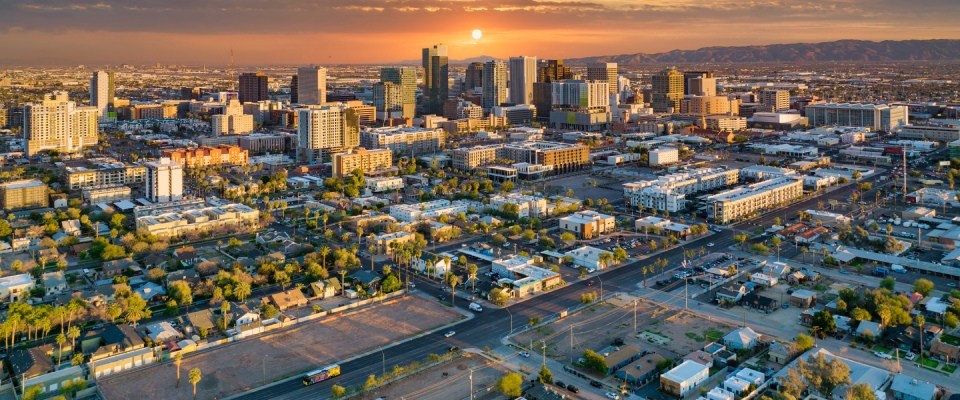
Other public transit options give renters more location-specific routes. Light rail delivers fast, frequent service along a central corridor that connects Downtown Phoenix, Midtown, Tempe and Mesa. The S Line Streetcar provides a focused loop for renters in the Tempe area, especially students and young professionals near ASU. And Dial-a-Ride ensures that residents with ADA-certified needs have reliable, door-to-door transportation throughout the city.
As you search for your next apartment, factor transit into your decision alongside rent, amenities and floor plans. Phoenix continues to expand its transit network, with light rail extensions into west Phoenix already in development, so choosing a transit-friendly neighborhood today positions you well for the years ahead.
FAQ
A: Valley Metro Light Rail and high-frequency bus routes along corridors like Central Avenue and Thomas Road are the most dependable options for daily commuting, with light rail trains arriving every 12 to 20 minutes throughout the day.
A: Downtown Phoenix, Midtown, the Central Avenue Corridor, Roosevelt Row and Downtown Tempe rank among the most transit-connected neighborhoods, thanks to overlapping light rail, bus and streetcar service.
A: Renters in urban neighborhoods near light rail and major bus routes, like Downtown Phoenix, Midtown and Tempe, can manage daily life comfortably without a car.
A: Light rail connects directly to Arizona State University’s Tempe and Downtown Phoenix campuses, and major employment centers along Central Avenue and in the Tempe–Mesa corridor are well served by both rail and express bus routes.
A: Different services have different ways to pay. Valley Metro uses the Copper Card, a contactless smartcard, and the Valley Metro mobile app.
Share this article:


Adina Dragos
Adina Dragos is a real estate writer and research analyst with RentCafe. She has solid experience in real estate writing, covering topics ranging from best cities for renters and the top cities for rental activity to cost of living. Her work was featured in several prominent media channels such as Axios, The Dallas Morning News, ConnectCRE and The New York Times.
Sign up for The Ready Renter newsletter
Get our free apartment hunting guide — plus local insights, trends and research.




Related posts

Detroit vs Chicago: Which Midwest city is more affordable for renters?
Detroit and Chicago are about 280 miles apart, making a move between the two a realistic option for many Midwestern renters. Maybe you’ve landed a…

Public transit options for renters in Newark, NJ: How to get around without a car
Newark renters can live car-free using PATH, NJ Transit rail, the Newark Light Rail and an extensive bus network, with Manhattan reachable in about 20…

San Diego vs. Los Angeles: Which city fits your renter budget?
Los Angeles and San Diego share a coastline, a climate and a reputation for expensive rent, but the day-to-day cost of living in each city…
Subscribe to
The Ready Renter newsletter