Share this article:


Over the last decade, developers completed more than 32,000 new apartments across Philadelphia, offering renters substantially more affordable options than coastal cities while maintaining strong transit access and urban amenities. Understanding where construction concentrated can help apartment hunters find the best combination of location, value, and lifestyle fit.
Which Philadelphia neighborhoods added the most apartments?
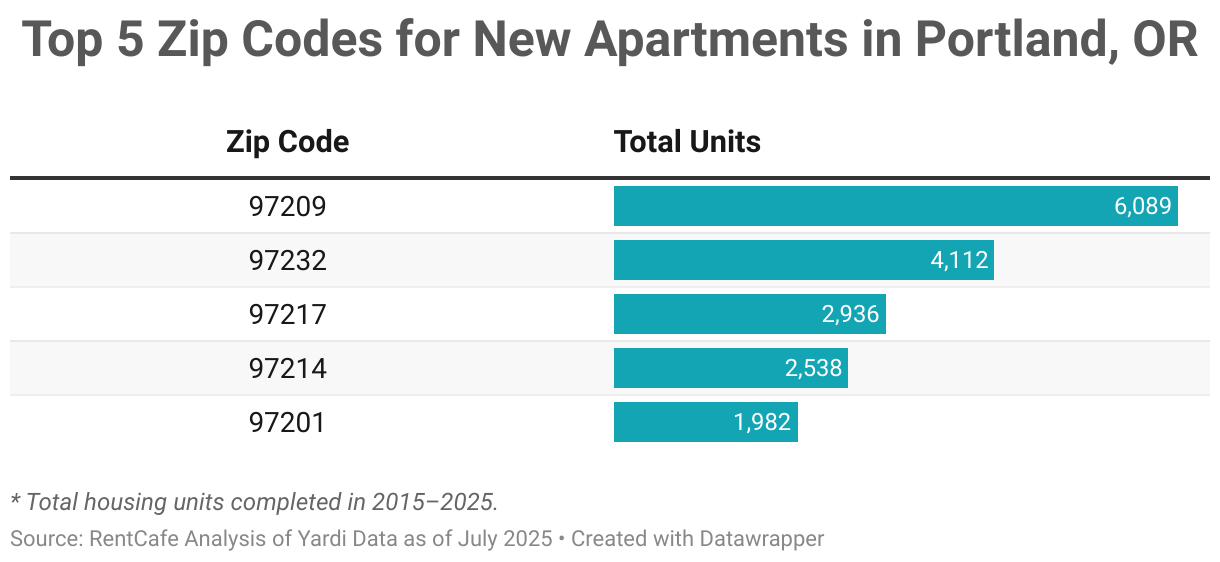
Here’s where construction focused over the last decade:
-
- Zip code 19104 added 4,459 new apartments, the most in the metro area.
- Zip code 19123 gained 4,268 new rentals.
- Zip code 19130 welcomed 2,243 new apartments.
- Zip code 19107 added 2,235 new rentals.
- Zip code 19103 built 2,093 new apartments.
Living in Philadelphia offers a balance between the energy of a major city and the affordability of a mid-sized one. The cost of living here is about 10% higher than the Pennsylvania state average and 5% higher than the national average, but still notably below that of cities like New York, Boston, or Washington, D.C.
To help renters navigate this expanding market, we’ve identified the areas where new apartment development is most concentrated:
4,459 new apartments put zip code 19104 at the top of Philadelphia’s construction list
Zip code 19104 added 4,459 new apartments, making it Philadelphia’s most active area for new residential development. The zip code covers University City west of the Schuylkill River, including areas near Market Street, Walnut Street, and Baltimore Avenue.
Transit options include the Market-Frankford Line, multiple SEPTA trolley routes (10, 11, 13, 34, 36), Regional Rail at 30th Street Station, and university shuttles such as LUCY. Major employers include the University of Pennsylvania, Drexel University, Penn Medicine, Children’s Hospital of Philadelphia, and the University City Science Center, with Center City reachable in about 10–15 minutes.
Zip code 19123 added 4,268 new apartments
Zip code 19123 gained 4,268 new apartments, reflecting continued residential growth just north of Center City. The zip code sits between Old City and Fishtown and includes former industrial areas redeveloped into mixed-use residential corridors.
The area is served by the Market-Frankford Line at Spring Garden and Girard stations, along with multiple bus routes and the Route 15 trolley. Center City employment hubs are typically under 10 minutes away by subway, while nearby job centers include Old City offices, Fishtown hospitality businesses, and downtown finance, tech, and professional services firms.
2,243 new apartments expand housing options in zip code 19130
Zip code 19130 added 2,243 new apartments, increasing rental options north of Center City near Fairmount Park. The zip code stretches from Vine Street to Girard Avenue, offering access to major cultural institutions and green space.
Transit access includes the Market-Frankford Line at Spring Garden, the Broad Street Line along the eastern edge, and several bus routes. Center City jobs are about 10–15 minutes away, while University City employers—including hospitals and universities—are reachable in roughly 15–20 minutes.
Zip code 19107 delivers 2,235 new apartments
Zip code 19107 added 2,235 new apartments across nine buildings, placing renters in the heart of downtown Philadelphia. The zip code includes portions of Washington Square West and sits within walking distance of many of the city’s core employment and entertainment destinations.
The area benefits from access to both subway lines, multiple trolley routes, and Regional Rail at Jefferson and Suburban Stations. Center City’s employment base includes Comcast, law firms, healthcare systems, universities, hospitality, and professional services, allowing many residents to walk to work.
2,093 new apartments grow zip code 19103’s inventory
Zip code 19103 added 2,093 new apartments, reinforcing its position as one of Philadelphia’s most established residential zip codes. The area surrounds Rittenhouse Square and sits between Market Street and the Schuylkill River.
Residents rely on nearby Market-Frankford and Broad Street Line stations, extensive bus service, and Suburban Station for Regional Rail. Employment opportunities surround the zip code, with dense concentrations of law firms, consulting companies, financial services, and corporate offices, while University City employers remain accessible within 15–20 minutes.
Top 5 zip codes for new apartments in Philadelphia, PA
| Zip code | New apartments |
|---|---|
| 19104 | |
| 19123 | |
| 19130 | |
| 19107 | |
| 19103 |
* Total new apartments completed between 2015 and 2025.
Source:
RentCafe.com analysis of Yardi data as of July 2025
Philadelphia’s rental market remains resilient as steady employment and institutional demand continue to drive multifamily performance across the city. Development has concentrated in submarkets offering strong job access, walkability, and lifestyle amenities, supporting long-term renter interest in urban neighborhoods.
While new supply has entered the pipeline, consistent demand from healthcare, education, and tech sectors has kept the market balanced. Ongoing economic diversification and a growing population of young professionals and remote workers continue to reinforce Philadelphia’s position as one of the Mid-Atlantic’s most stable and dynamic rental markets.
FAQ: Renting in Philadelphia’s fastest-growing zip codes
Q: How many new apartments have been built across these top Philadelphia zip codes in total?
A: A total of 32,006 new apartments have been completed across Philadelphia over the last ten years.
Q: Which zip codes have the most new apartments in Philadelphia, and how many were built in each?
A: Zip code 19104 leads the metro with 4,459 new apartments, followed by 19123 with 4,268, 19130 with 2,243, 19107 with 2,235, and 19103 with 2,093.
Q: How accessible are Philadelphia’s high-supply neighborhoods by public transportation?
A: Most high-supply neighborhoods have excellent transit access, served by the Market-Frankford Line, Broad Street Line, trolleys, buses, and Regional Rail — all offering quick connections to Center City and University City.
Q: Which major employers are within commuting distance of Philadelphia’s top construction areas?
A: Major employers include the University of Pennsylvania, Drexel University, Penn Medicine, CHOP, Comcast, and a wide range of healthcare, corporate, and professional services firms.
Q: How does the cost of living in Philadelphia compare to the average for Pennsylvania?
A: The cost of living in Philadelphia is about 10% higher than the Pennsylvania state average and roughly 5% higher than the national average.
Methodology
RentCafe.com is a nationwide apartment search website that enables renters to easily find apartments and houses for rent throughout the U.S.
This study uses data from 2015–2025, with the ‘past decade’ referring to this period.
Share this article:


Adina Dragos
Adina Dragos is a real estate writer and research analyst with RentCafe. She has solid experience in real estate writing, covering topics ranging from best cities for renters and the top cities for rental activity to cost of living. Her work was featured in several prominent media channels such as Axios, The Dallas Morning News, ConnectCRE and The New York Times.
Sign up for The Ready Renter newsletter
Get our free apartment hunting guide — plus local insights, trends and research.




Related posts
Detroit vs Chicago: Which Midwest city is more affordable for renters?
Detroit and Chicago are about 280 miles apart, making a move between the two a realistic option for many Midwestern renters. Maybe you’ve landed a…
Public transit options for renters in Newark, NJ: How to get around without a car
Newark renters can live car-free using PATH, NJ Transit rail, the Newark Light Rail and an extensive bus network, with Manhattan reachable in about 20…

Lining up apartment tours in Nashville, TN? Ask these questions first
Nashville runs on two engines that rarely slow down: health care and music. It’s a city where a hospital shift change, a songwriter’s set and…
Subscribe to
The Ready Renter newsletter