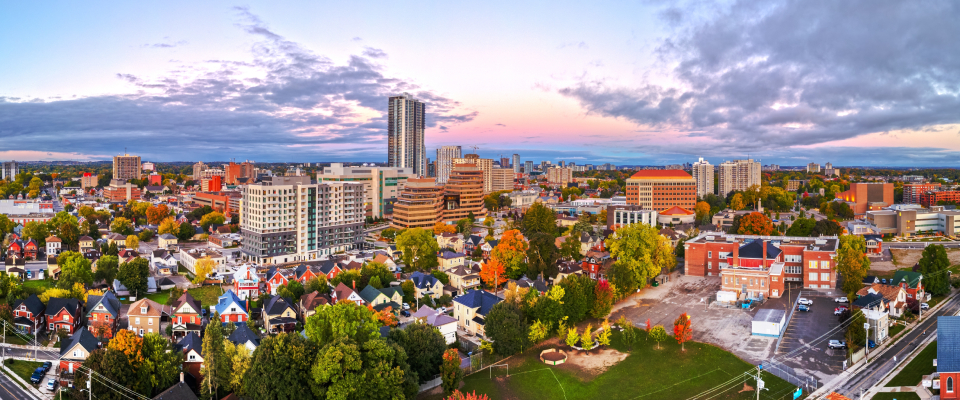
Best cities for renters to live in 2026: McKinney, TX, leads again in a South-dominated top 50
Share this article:


For the second year in a row, McKinney, TX, holds the top spot in RentCafe.com’s ranking of the best cities for renters. This year, Southern cities account for 37 of the top 50, reinforcing the region’s reputation for affordability and economic opportunity.
When you’re searching for the right city to call home, a few factors matter most. Namely, how far your budget stretches, whether the job market aligns with your career and what daily life looks like once you’ve settled in.
With that in mind, this year’s rankings spotlight a wide mix of cities that deliver across all three — giving renters meaningful options across a range of priorities.
Key takeaways:
- McKinney, TX, returns as the nation’s top city for renters, followed by Huntsville, AL, in second place and Austin, TX, in third.
- San Marcos, TX, ranks first for cost of living and housing; Miami leads in local economy; and Washington, D.C. makes its third appearance as the nation’s top city for quality of life.
- Southern cities continue to dominate the top 50 with Florida, Texas and North Carolina being the most represented states.
To determine the best cities for renters, RentCafe.com analyzed 20 key metrics across 150 U.S. cities. These included measures such as affordability, renter income growth, number of social associations (civic groups, clubs and community organizations) and walkability. The metrics were then grouped into three broader categories — cost of living and housing; local economy; and quality of life.
20 metrics to keep in mind when choosing a place to live in 2026

Whether you’re seeking the energy of a fast-growing tech hub or the appeal of a smaller, more relaxed city, the rankings highlight where you can find the best combination of value, opportunity and livability in 2026.
Biggest movers: Who’s new, who returned and who climbed the ranks
Several cities made notable moves this year. For instance, Birmingham, AL, returns to the top 50 (being absent since 2023) after climbing 28 spots to #40. Similarly, Savannah, GA, climbs 21 spots to #45 — marking its first appearance in the study’s top 50 — fueled in part by a strong, 16th-place finish in cost of living and housing. Additionally, Westminster, CO, is also back in the top 50 after rising 24 spots to #48, while Bradenton, FL, reenters the list after climbing 15 spots to #37, bolstered by a 12th-place ranking in cost of living and housing.
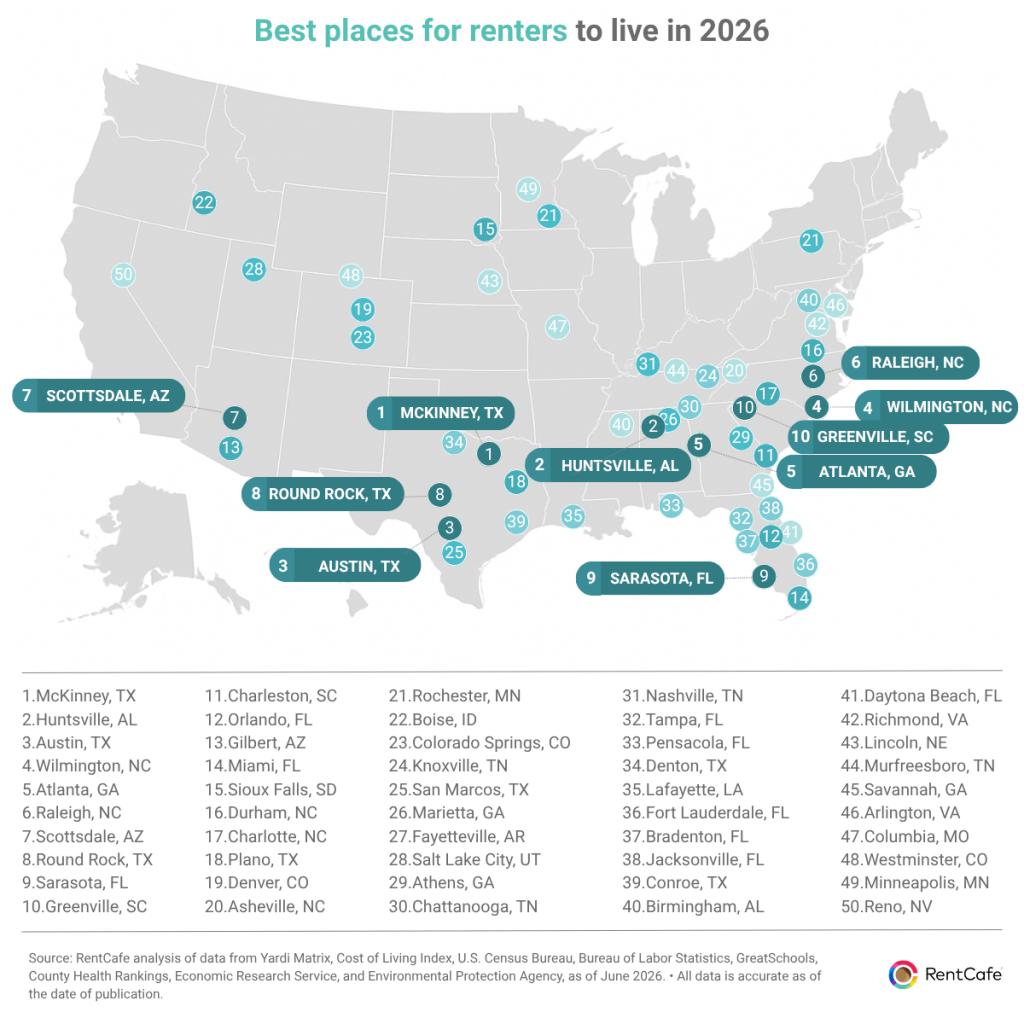
At the other end of the spectrum, several cities move out of the top 50 this year. Specifically, Gainesville, FL, exits the top 50 for the first time, after dropping 27 spots to #61. It was weighed down by a weaker performance in cost of living and housing. Fort Worth, TX, also moves out of the ranking, falling 27 spots to #65. And San Antonio, TX, drops 19 spots to #63.
Top 5 best cities for renters in 2026
1. McKinney, TX
McKinney holds on to the top spot in 2026, earning its place as the best city for renters for the second year running. The city ranks third in cost of living and housing, as well as ninth in quality of life, thanks to a high share of high-end rentals, a 35.9% rise in renter household incomes and access to highly rated schools.
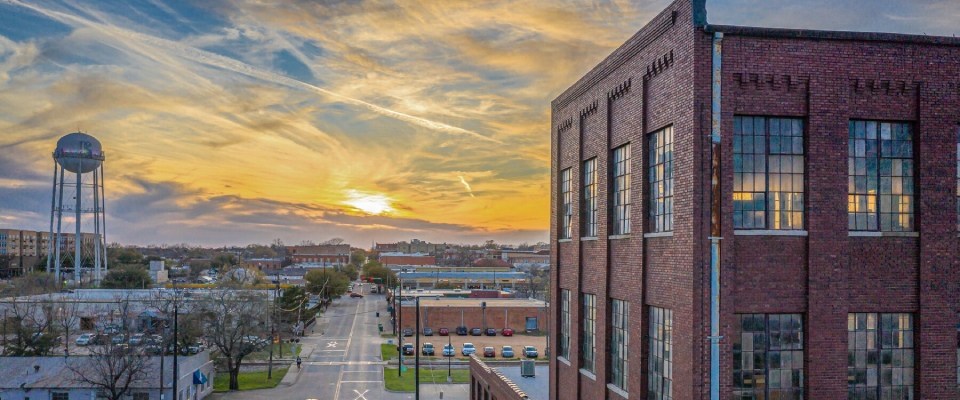
Beyond housing, renters here also enjoy more than 3,000 acres of parks and open space spread across 106 parks; more than 80 miles of connected trails; and multiple aquatic centers.
2. Huntsville, AL
Jumping three spots from last year to claim second place, Huntsville places high in both cost of living and housing (#2), as well as local economy (#6). More precisely, the city benefits from a lower-than-average cost of living, a growing share of new apartments and a 60.4% increase in income gains for renters.
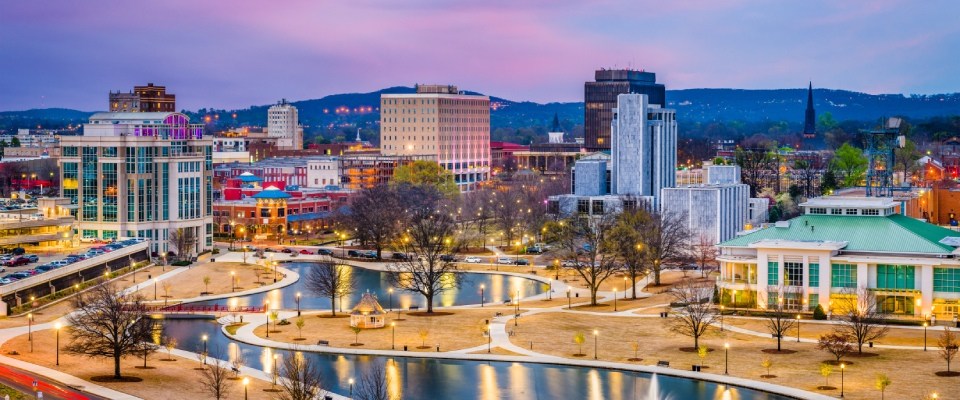
Huntsville’s economy is powered by aerospace, defense and advanced manufacturing with major employers including NASA’s Marshall Space Flight Center and Blue Origin. The city is also a great fit for socially active renters as it offers a wide range of opportunities for community engagement and recreation. Highlights include Monte Sano State Park, the Huntsville Botanical Garden, nearly 30 miles of greenways and thriving arts and entertainment districts.
Best places for renters to live in 2026
Check out all the metrics used to create the index by scrolling right
Index covers the 150 largest and fastest-growing U.S. cities with sufficient rental data available.
Overall rank blends three weighted categories: housing & cost of living (40%), local economy (35%) and quality of life (25%).
Source: RentCafe analysis of data from Yardi Matrix, Cost of Living Index, U.S. Census Bureau, Bureau of Labor Statistics, GreatSchools, County Health Rankings, Economic Research Service, and Environmental Protection Agency, as of June 2026. • All data is accurate as of the date of publication.
3. Austin, TX
Austin moves up one spot from last year to secure third place overall by performing well in local economy (#4) and cost of living and housing (#8). Of course, the city’s status as a major education center and its entrepreneurial culture contribute to its appeal, along with better-than-average air quality.
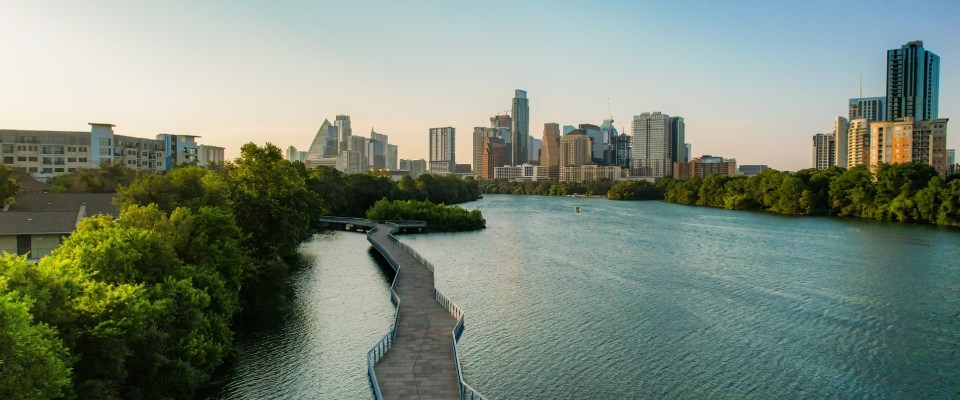
Austin also remains one of the nation’s leading technology and innovation hubs, hosting major operations for Tesla, Apple, Google, Dell and Samsung. The city is also known for globally recognized events, such as SXSW and the Austin City Limits Music Festival, while the University of Texas at Austin serves as a major economic engine, driving research, innovation, patents and startup activity throughout the region.
4. Wilmington, NC
Wilmington ranks fourth overall, performing well in local economy (#5) and cost of living and housing (#11). With that, the city climbed two positions from last year, supported by its below-average cost of living, 49.4% renter income growth and job opportunities. Plus, Wilmington offers shorter commutes than many other metro areas.
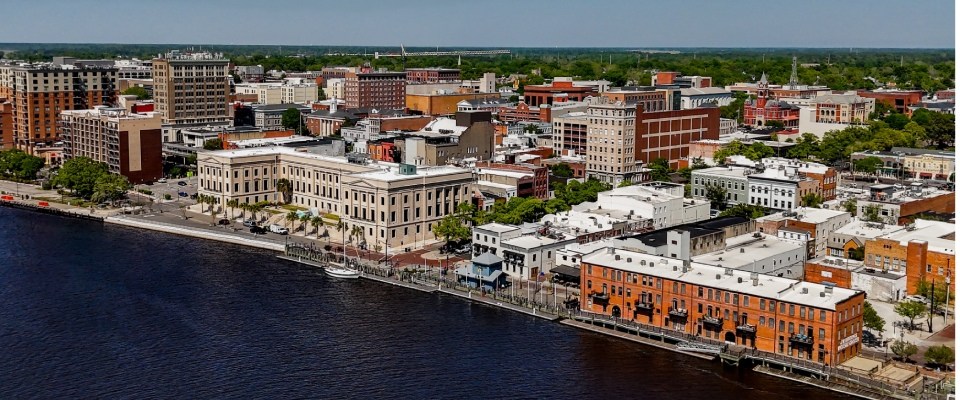
In this case, the city offers renters a range of employment opportunities across health care, education, biotechnology, tourism and film production with Cinespace Wilmington being one of the largest film production facilities in the U. S. outside of California.

Southern cities have consistently delivered a combination of lower living costs, expanding rental stock and fast-growing local economies that other regions struggle to match at scale. Cities like McKinney, Huntsville and Austin show that renters don’t have to sacrifice quality of life for affordability and that economic opportunity in the South extends well beyond a handful of major metros.
5. Atlanta, GA
Rounding out the top five is Atlanta, which dropped two positions from last year. Yet, despite this shift, it remains one of the nation’s best cities for renters, ranking second overall in local economy.
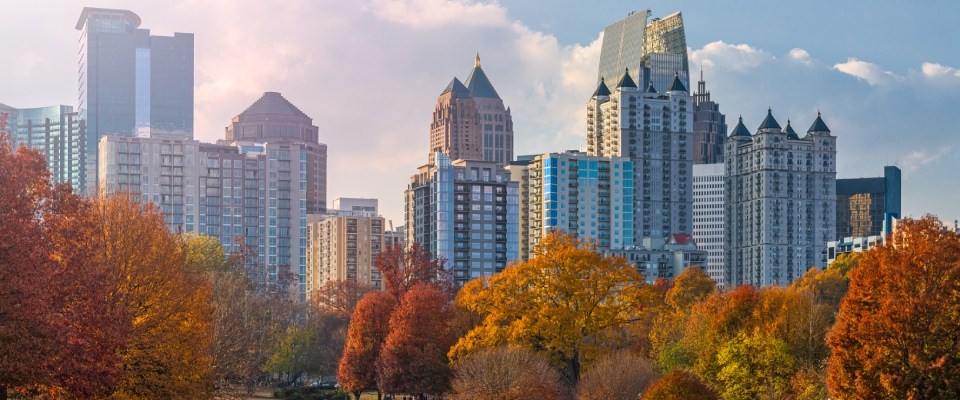
Atlanta’s performance is driven by its large share of highly educated residents, rising renter incomes and entrepreneurial environment. Widely regarded as the economic capital and tech hub of the Southeast, Atlanta is home to 17 Fortune 500 companies and is also a major higher education hub, anchored by institutions such as Georgia Tech, Emory University, Georgia State University and the Atlanta University Center.
Best cities for renters in the South: Budget-friendly living with room to grow
Beyond the top five, strong options emerge across every region of the country. Granted, Southern cities continue to dominate the rankings, performing particularly well in the cost of living and housing and local economy categories.

In addition to the top five cities, the region is represented by several other standout destinations, such as Raleigh, NC, which ranks 13th in cost of living and housing; 15th in local economy and 17th in quality of life.
Close behind is Round Rock, TX, which places fourth in cost of living and housing and 20th in quality of life. Other notable Southern cities include Sarasota, FL (ninth in cost of living and housing and 18th in quality of life); Greenville, SC (20th in cost of living and housing; 16th in local economy and 28th in quality of life) and Charleston, SC (30th in cost of living and housing and 10th in local economy).
Best cities for renters in the West: Career growth meets outdoor living
The West is the second-most-represented region in the top 50, led by Scottsdale, AZ, which secures seventh place overall. In fact, the city ranks ninth in local economy and fifth in quality of life.

Other top-performing Western cities that rank high in local economy include Gilbert, AZ (#21); Denver (#3); Boise, ID (#7) and Salt Lake City (#23). Meanwhile, Colorado Springs, CO, earns the 18th spot in quality of life, with the same score as Sarasota, FL.
Further west, Seattle also continues to attract renters and occupies the eighth place in the local economy ranking and 10th place in quality of life. The city appeals to renters thanks to its range of major employers — from tech giants like Amazon, Microsoft and Google to health care systems like Providence Swedish and retailers like Costco — which fuel a strong local economy.
Best cities for renters in the Midwest: Community, affordability and opportunity
Sioux Falls, SD, leads the Midwest, ranking seventh in cost of living and housing. With a cost of living below the national average and a socially active community, Sioux Falls is a strong choice for renters looking for both affordability and networking.

Other notable Midwestern cities include Rochester, MN, which ranks 27th in local economy and 11th in quality of life, and Ann Arbor, MI, which places 13th in quality of life. Both cities appeal to renters looking for small-town charm and a strong community infrastructure with plenty of well-regarded schools, parks and health care access.
Best cities for renters in the Northeast: Quality of life remains unmatched
For renters prioritizing quality of life, the Northeast remains one of the top-performing regions in this category. That’s because, cities throughout the Northeast offer access to world-class health care systems, prestigious universities and cultural amenities. What’s more, the public transit network within these metros remains among the nation’s best, helping reduce reliance on personal vehicles while keeping residents connected to the broader Northeast corridor.

This year, Albany, NY, leads the Northeast, ranking 30th in local economy and 23rd in quality of life. Pittsburgh, Boston and Manhattan, NY, also stand out for their quality-of-life ranking, landing 27th, 14th and third in the category, respectively.
To that end, while Manhattan is often associated with steep housing costs, it still shines in several quality-of-life metrics — including apartments in top locations, extensive public transit and a high number of social associations — despite not cracking the overall top 50.
Which are the best cities for renters in each category?
This year, San Marcos, TX, claims the top spot in the cost of living and housing category thanks to its lower cost of living and growing inventory of new and high-end apartments.
Most vs. least favorable cities for renters in 2026
A side-by-side look at the top and bottom performers in each ranking category
San Marcos, TX
- Cost of living:-13.8%
- Average apartment size:988 sq. ft.
- Occupancy rate:84.5%
- Share of new apartments:30.6%
- Share of high-end apartments:69.4%
- Share of renter households:69.2%
- Market competitiveness index:67.4
- Average property ratings:4.2
Manhattan, NY
- Cost of living:+138.9%
- Average apartment size:759 sq. ft.
- Occupancy rate:98.2%
- Share of new apartments:4.0%
- Share of high-end apartments:40.1%
- Share of renter households:74.9%
- Market competitiveness index:84.2
- Average property ratings:3.9
Miami, FL
- Unemployment rate:5.2%
- Share of higher educated residents:28.5%
- Renter income growth:62.1%
- Job growth:-0.2%
- No. of business applications:496
Harrisburg, PA
- Unemployment rate:11.4%
- Share of higher educated residents:16.5%
- Renter income growth:14.2%
- Job growth:+0.1%
- No. of business applications:138
Washington, D.C.
- Apartments in top locations:55.4%
- Average school quality:5.3
- Long commutes alone:47.2%
- Using public transport or walking:29.2%
- Natural amenity rank:3
- Average air quality:45
- Social association rate:29.4
Riverside, CA
- Apartments in top locations:13.8%
- Average school quality:4.9
- Long commutes alone:46.9%
- Using public transport or walking:2.6%
- Natural amenity rank:6
- Average air quality:87
- Social association rate:4.4
Source: RentCafe analysis of data from Yardi Matrix, Cost of Living Index, U.S. Census Bureau, Bureau of Labor Statistics, GreatSchools, County Health Rankings, Economic Research Service, and Environmental Protection Agency, as of June 2026. • All data is accurate as of the date of publication.
Meanwhile, Miami remains the top city in local economy for the third year in a row, with renters here benefiting from entrepreneurial opportunities, as well as steady renter income growth, despite job growth stagnating.
Finally, Washington, D.C. once again ranks first in quality of life. The nation’s capital stands out for its walkability, abundance of apartments in desirable locations and extensive green spaces.
FAQ
A: McKinney, TX, ranks as the best city for renters in 2026, earning high marks for cost of living and housing (third overall) and quality of life (ninth).
A: RentCafe.com evaluated 150 U.S. cities across 20 metrics grouped into three categories: cost of living and housing; local economy and quality of life. Metrics included affordability, renter income growth, number of social associations and walkability, among others.
A: San Marcos, TX, leads in cost of living and housing; Miami tops the local economy category; and Washington, D.C. ranks first for quality of life.
A: The South dominates, accounting for 37 of the top 50 cities. Florida, Texas and North Carolina are the most-represented states. The West is the second-most-represented region.
A: The top five consists of McKinney, TX; Huntsville, AL; Austin, TX; Wilmington, NC; and Atlanta.
A: Yes. In the West, Scottsdale, AZ, ranks seventh overall. In the Midwest, Sioux Falls, SD, leads the region. In the Northeast, cities like Boston and Manhattan, NY, stand out for quality of life, ranking 14th and third in that category, respectively.
Methodology
The Best Cities for Renters ranking was compiled by RentCafe.com, a nationwide apartment search website that enables renters to easily find apartments and houses for rent throughout the United States.
We only considered “suitable candidates for best cities for renters” as those cities with an apartment stock of at least 10,000 apartment units. Cities with lower apartment stocks were excluded. A total of 150 cities were the final candidates for the ranking.
To determine the best cities for renters, the RentCafe.com analytics team used a composite index to compare cities across three main categories — cost of living and housing; local economy; and quality of life.
The three main categories were compiled from 20 relevant metrics. Each metric received a score based on a minimum and maximum value multiplied by the metric’s weight.
To create the categories index, the ranking process was repeated and then the results were multiplied by each category’s overall weight.
Data provided is as of June 2026 by Yardi Matrix, a RentCafe.com sister company. It covers apartment buildings of 50 units or more. All data is accurate as of the date of publication. All sources used are cited below.
Ranking metrics and data sources:
Category 1: Housing & cost of living (category weight: 40%)
- Cost of living and housing; Weight: 35%; Source: The Cost of Living Index – 2025.
- Apartment average size; Weight 11%; Source: Yardi Matrix, average size of all inventory, excluding affordable apartments.
- Apartment occupancy; Weight: 12%; Source: Yardi Matrix.
- Share of new apartments; Weight: 12%; Source: Yardi Matrix.
- Share of high-end apartments; Weight: 10%; Source: Yardi Matrix.
- Share of renter-occupied households; Weight: 5%; Source: Bureau of Census – American Community Survey 2024 Five-Year Estimates.
- Market Competitiveness; Weight: 5%; Source: RentCafe Market Competitiveness Report – Q1 2026.
- RentCafe ILS Property Ratings; Weight: 10%; Source: RentCafe.com.
Category 2: Local economy (category weight: 35%)
- Unemployment rate; Weight: 25%; Source: Bureau of Census – American Community Survey 2024 Five-Year Estimates.
- Share of population with higher-education degrees; Weight: 20%; Source: Bureau of Census – American Community Survey 2024 Five-Year Estimates.
- Renter household median income growth; Weight: 25%; Source: Bureau of Census – American Community Survey 2024 Five-Year Estimates vs 2019.
- Job growth; Weight: 15%; Source: Bureau of Labor Statistics.
- Number of business applications per 10,000 residents; Weight: 15%; Source: Bureau of Census – Business Formation Statistics.
Category 3: Quality of life (category weight: 25%)
- Apartments in top locations; Weight: 20%; Source: Yardi Matrix.
- Average school rating; Weight: 15%; Source: GreatSchools.org.
- Long commutes driving alone; Weight: 15; Source: County Health Data 2024 (Long commutes – more than 30 minutes).
- Share of public transportation users & walking; Weight: 15%; Source: Bureau of Census – American Community Survey 2020 – 5 – Year Estimates.
- Natural amenity rank; Weight: 5%; Source: Economic Research Service – Department of Agriculture.
- Average air quality; Weight: 10%; Source: EPA Air Quality.
- Social association rate; Weight: 20%; Source: County Health Data 2025.
Fair use and redistribution
We encourage you and freely grant you permission to reuse, host, or repost the research, graphics, and images presented in this article. When doing so, we ask that you credit our research by linking to RentCafe.com or this page, so that your readers can learn more about this project, the research behind it and its methodology. For more in-depth, customized data, please contact us at media@rentcafe.com.
Share this article:


Adina Dragos
Adina Dragos is a real estate writer and research analyst with RentCafe. She has solid experience in real estate writing, covering topics ranging from best cities for renters and the top cities for rental activity to cost of living. Her work was featured in several prominent media channels such as Axios, The Dallas Morning News, ConnectCRE and The New York Times.
Sign up for The Ready Renter newsletter
Get our free apartment hunting guide — plus tips, trends and research.




Related posts
Millionaire renters more than triple in 5 years, nearly half are Millennials
The number of millionaire renter households in the U.S. grew 229% between 2020 and 2024, more than tripling in just five years. While New York…
Detroit vs Chicago: Which Midwest city is more affordable for renters?
Detroit and Chicago are about 280 miles apart, making a move between the two a realistic option for many Midwestern renters. Maybe you’ve landed a…
Public transit options for renters in Newark, NJ: How to get around without a car
Newark renters can live car-free using PATH, NJ Transit rail, the Newark Light Rail and an extensive bus network, with Manhattan reachable in about 20…
Subscribe to
The Ready Renter newsletter