U.S. apartment sizes are growing: Where are renters gaining the most space?
Share this article:


If you’re hoping for larger floor plans, the good news is that apartment sizes have increased in 2025 compared to the previous year. More precisely, floor plans currently average 910 square feet nationwide with every unit type having gained additional living space. As apartment sizes expand, much of that growth is concentrated in Southern markets, where larger floor plans remain a defining feature.
Key takeaways:
- The typical size of apartments in 2025 increased by 13 square feet, reaching 910 square feet.
- All apartment types gained additional square footage with three-bedroom apartments seeing the largest year-over-year increase at 28 square feet.
- Tallahassee, FL, is home to the largest apartments in the nation, averaging 1,156 square feet.
- Seattle has the smallest apartments in the U.S., down 47 square feet compared to 10 years ago.
- Apartments in major hubs like San Francisco and Queens, NY, gained square footage, adding 35 and 16 square feet in 10 years, respectively.
Among the cities with the most notable increases, Frisco, TX, and St. Petersburg, FL, are the biggest standouts: The average apartment in both cities is now 55 square feet larger than it was a decade ago. Meanwhile, Florida’s Tallahassee and Gainesville offer some of the nation’s largest apartments, while Seattle and Portland, OR, remain home to the smallest.
New apartments continue getting larger, breaking a decade-long pattern
Source: RentCafe analysis of Yardi data as of May 2026 • All data is accurate as of the date of publication.

To determine which cities have seen the biggest changes in rental size during the last decade, RentCafe.com examined the size of apartments across the 100 largest cities in the U.S. We looked at the markets with the largest and smallest apartments, as well as those that experienced the most significant changes in square footage since 2016.
Apartments are getting larger across the nation
Renters searching for apartments this rental season are more likely to find a place with a bit more breathing room as all units have become larger overall. For example, studios gained six square feet to now average 460 square feet, whereas one-bedroom and two-bedroom apartments average 735 and 1,095 square feet, respectively.
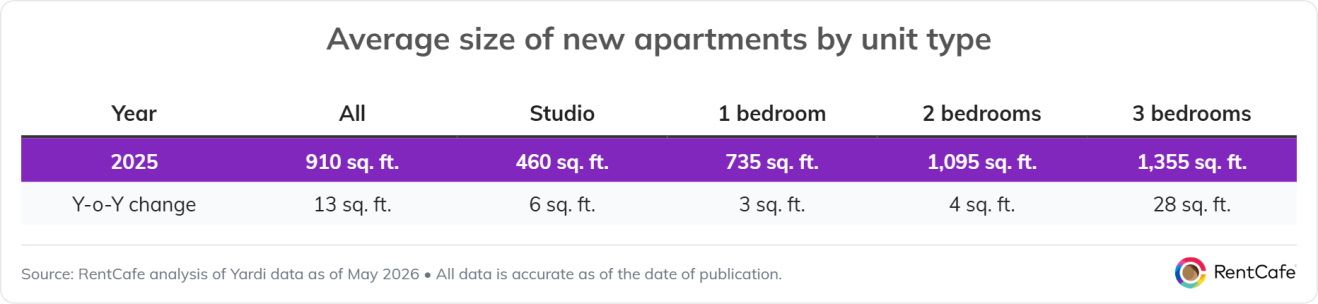
However, the most notable increase occurred among three-bedrooms: These apartments gained 28 square feet year-over-year — the equivalent of a small balcony — and now average 1,355 square feet, which further pushes the national average higher.
Several factors likely contribute to the nationwide increase in average apartment size. First, with new apartments entering the market, developers are offering more square footage to stand out and attract renters.
At the same time, more people are moving toward Southern markets — where land is more affordable and apartments tend to be larger — which is pulling the national average upward.
The increase also suggests that demand for larger living spaces remains strong, especially among renters seeking flexibility for family life, remote work or evolving household needs.
Share of apartments built by unit type
| Studio | 1 bedroom | 2 bedroom | 3 bedroom | |
|---|---|---|---|---|
| 2025 | 5.2% | 47.7% | 39.5% | 7.1% |
| Last 10 years | 5.7% | 48.0% | 38.2% | 6.8% |
| Historical | 4.6% | 42.2% | 44.5% | 8.6% |
“Last 10 years” refers to apartments completed between 2016 and 2025.
“Historical” represents apartments completed before 2016.
Source: RentCafe analysis of Yardi data as of May 2026 • All data is accurate as of the date of publication.
That said, smaller apartments are still the most popular among developers. In fact, one-bedroom apartments and studios continue to dominate, accounting for a combined 52.9% of apartments in 2025.
Meanwhile, two- and three-bedroom apartments account for a slightly smaller share than they did a decade ago: Two-bedrooms make up 39.5% of new apartments, while three-bedrooms represent 7.1%.
10-year evolution by unit type
Source: RentCafe analysis of Yardi data as of May 2026 • All data is accurate as of the date of publication.
Where can you find the most spacious apartments?
If bigger floor plans are a priority, look to the South. Specifically, three Florida cities rank among the top five for largest apartment size, with Tallahassee and Gainesville taking the top spots.
First, in Tallahassee, FL, new apartments average 1,156 square feet. Although floor plans shrank by 27 square feet compared to 10 years ago — roughly the size of a typical walk-in closet — you’ll still find more living space here than in any other city in the country.
Top 20 cities with the largest new apartments
| Rank | City, state | Average size of new apartments | 10-year net change | 10-year percentage change |
|---|
Average size is in square feet.
To ensure a statistically relevant sample size at city level, new apartments refer to completed units built between 2016 and 2025.
The change is calculated by comparing the average size of new apartments with the average size of apartments completed between 2006 and 2015.
Source: RentCafe analysis of Yardi data as of May 2026 • All data is accurate as of the date of publication.
Next, Gainesville, FL, ranks second, with units averaging 1,126 square feet — an increase of 29 square feet compared to a decade ago. Then, Baton Rouge, LA, comes in third with new units averaging 1,042 square feet. Apartment sizes here increased by 11 square feet.
In fourth place is Knoxville, TN, where apartments average 1,032 square feet despite shrinking by 44 square feet since 2016. However, two- and three-bedrooms still make up most of what’s available, keeping overall sizes on the larger side despite the decrease in square footage.
Finally, Fort Myers, FL, takes the fifth spot, also averaging 1,032 square feet. Here, the typical apartment size decreased by 13 square feet, which is about the size of a linen closet.
Just like in Knoxville, two- and three-bedroom apartments in Fort Myers still outnumber smaller units, which keeps the overall average size high, even though these larger units have themselves become smaller compared to the previous decade.
Where are the smallest apartments? Western and Northeastern cities lead
Although apartment sizes have increased across the country since 2016, not all cities have benefited from larger floor plans. Namely, Seattle now has the smallest new apartments in the nation, averaging 645 square feet after losing 47 square feet. This reflects the trend of more studios and one-bedrooms being built in recent years.
Top 20 cities with the smallest new apartments
| Rank | City, state | Average size of new apartments | 10-year net change | 10-year percentage change |
|---|
Average size is in square feet.
To ensure a statistically relevant sample size at city level, new apartments refer to completed units built between 2016 and 2025.
The change is calculated by comparing the average size of new apartments with the average size of apartments completed between 2006 and 2015.
Source: RentCafe analysis of Yardi data as of May 2026 • All data is accurate as of the date of publication.
Nearby Portland, OR, follows closely, with the typical apartment size shrinking by 47 square feet and averaging 665 square feet.

When we see average apartment sizes decrease in a city, it doesn’t necessarily mean renters are getting less value. In high-demand markets, developers often prioritize studios and one-bedrooms because they can deliver more apartments per building and meet the needs of a growing number of single-person and smaller households. The trade-off is a lower average square footage, but the upside is more availability in markets where inventory has historically been tight.
Similarly, Tacoma, WA, experienced one of the largest reductions in living space among these markets. Apartments here lost 152 square feet compared to 10 years ago — the equivalent of a small bedroom.
In Tacoma, not only has new construction favored smaller layouts over three-bedroom floor plans, but every apartment type has also decreased in size — a combination that drove the steep decline. The shift may reflect demand spreading from Seattle into nearby Tacoma, with new construction designed to meet that influx of renters.
On the opposite coast, Brooklyn, NY ranks fourth among the cities with the smallest apartments, averaging 714 square feet, which is six square feet less than 10 years ago.
Back on the West Coast, San Francisco completes the top five with apartments averaging 717 square feet. Unlike the other cities in this group, San Francisco recorded a 35-square-foot increase in the last decade.
Which cities gained the most living space?
For renters prioritizing square footage, Frisco, TX, and St. Petersburg, FL, are worth a closer look. The cities lead the nation in apartment size growth, with the average unit gaining 55 square feet in the last decade.
That’s roughly enough room for a compact, in-unit laundry setup with a side-by-side washer and dryer. For Frisco, several factors are driving this growth: Two-bedrooms now make up a larger share of available apartments and three-bedroom floor plans have expanded in size, while the share of one-bedrooms has decreased.
Where apartments are getting larger
| Rank | City, state | Most significant changes in apartment size |
|---|
Change is in square feet.
Source: RentCafe analysis of Yardi data as of May 2026 • All data is accurate as of the date of publication.
Irvine, CA, ranks second. In this California city, apartments gained an additional 46 square feet compared to 10 years ago.
Further north, San Francisco follows with an increase of 35 square feet, making it one of the few major coastal markets to record significant growth in apartment size. A shift in San Francisco’s construction mix helps explain the increase: The share of studios has declined in recent years, replaced by a growing number of two-bedroom apartments.
Gainesville, FL, is fourth, adding 29 square feet to its new apartments during the same period.
Another noteworthy market bucking the shrinking trend is Queens. In this New York City borough, living space has increased by 16 square feet compared to the previous decade as all apartment types have grown in size since 2016.
Where are apartments becoming more compact?
Where you live makes a big difference, as apartment sizes are growing in some markets and shrinking in others. For example, apartments in Arlington, TX, recorded the largest decline among the nation’s 100 largest cities as the average size here decreased by 287 square feet, which is roughly the size of a master bedroom.
This is largely due to an increase in studios and one-bedroom apartments in recent years — both of which have also decreased in size — while two-bedroom options have become less common.
Where apartments are getting smaller
| Rank | City, state | Most significant changes in apartment size |
|---|
Change is in square feet.
Source: RentCafe analysis of Yardi data as of May 2026 • All data is accurate as of the date of publication.
Along the same lines, Birmingham, AL, and Columbia, SC, also experienced substantial decreases. In those cities, apartments are about 156 and 154 square feet smaller, respectively, compared to those built 10 years ago.
Finally, apartments in Detroit are now 153 square feet more compact than they were in the previous decade, while Tacoma, WA, rounds out the list with a decline of 152 square feet in the size of new apartments.
However, looking ahead, the pipeline of apartments currently under construction suggests that developers will continue to prioritize spacious floor plans, especially in the South. Among cities with the largest apartments under construction, Gallatin, TN, leads with an average size of 1,336 square feet, while three Florida cities — Palmetto (1,326 square feet), Ocala (1,202 square feet) and Vero Beach (1,163 square feet) — rank among the top five.
Meanwhile, cities like Newark, NJ (536 square feet), and Seattle (611 square feet) will most likely continue to favor more compact floor plans.
Average size of new apartments in 100 U.S. cities
| Rank | City, state | Average size of new apartments |
10-year net change | 10-year percentage change |
|---|
Average size is in square feet.
To ensure a statistically relevant sample size at city level, new apartments refer to completed units built between 2016 and 2025.
The change is calculated by comparing the average size of new apartments with the average size of apartments completed between 2006 and 2015.
Source: RentCafe analysis of Yardi data as of May 2026 • All data is accurate as of the date of publication.
FAQ
A: The average apartment size in the U.S. is 910 square feet, which is an increase of 13 square feet.
A: Tallahassee, FL, has the largest apartments, averaging 1,156 square feet. Gainesville, FL, ranks second at 1,126 square feet, followed by Baton Rouge, LA, at 1,042 square feet.
A: Seattle has the smallest apartments in the nation, averaging 645 square feet. Portland, OR, follows at 665 square feet, while Tacoma, WA, averages 684 square feet and Brooklyn, NY, comes in at 714 square feet.
A: Three-bedroom apartments saw the largest gain, adding 28 square feet over the last decade to average 1,355 square feet.
A: Frisco, TX, and St. Petersburg, FL, stand out as the cities with the largest gains, adding 55 square feet of living space. They are followed by Irvine, CA, with an increase of 46 square feet.
Methodology
This report was compiled by RentCafe.com, a nationwide apartment search website that enables renters to easily find apartments and houses for rent throughout the U.S.
The apartment size and rent data were provided by Yardi Matrix as of June 2026. Yardi Matrix is a RentCafe.com sister company specializing in apartment market intelligence and providing up-to-date information on large-scale, multifamily properties of 50 units or more in more than 177 U.S. markets. Unit types were categorized by the number of bedrooms (zero, one, two or three) as defined by Yardi Matrix. All data is accurate as of the date of publication.
Rankings were based on the top 100 U.S. cities with the largest stock of apartments (sometimes referred to as “largest cities for renters”) located in multifamily buildings of 50 units or more. To ensure a relevant sample size, we excluded cities where the number of units completed in one year was less than 500.
When looking at the changes in apartment size in each city, we considered “new apartments” as those units that were built between 2016 and 2025. This ensured a statistically relevant sample size and avoided yearly fluctuations that do not necessarily show a trend.
To measure changes in apartment size over time, units built between 2016 and 2025 were compared against those built in the previous decade (2006 to 2015).
Fair use and redistribution
We encourage you and freely grant you permission to reuse, host, or repost the research, graphics, and images presented in this article. When doing so, we ask that you credit our research by linking to RentCafe.com or this page, so that your readers can learn more about this project, the research behind it and its methodology. For more in-depth, customized data, please contact us at media@rentcafe.com.
Share this article:


Adina Dragos
Adina Dragos is a real estate writer and research analyst with RentCafe. She has solid experience in real estate writing, covering topics ranging from best cities for renters and the top cities for rental activity to cost of living. Her work was featured in several prominent media channels such as Axios, The Dallas Morning News, ConnectCRE and The New York Times.
Sign up for The Ready Renter newsletter
Get our free apartment hunting guide — plus tips, trends and research.




Related posts
Millionaire renters more than triple in 5 years, nearly half are Millennials
The number of millionaire renter households in the U.S. grew 229% between 2020 and 2024, more than tripling in just five years. While New York…
Detroit vs Chicago: Which Midwest city is more affordable for renters?
Detroit and Chicago are about 280 miles apart, making a move between the two a realistic option for many Midwestern renters. Maybe you’ve landed a…
Public transit options for renters in Newark, NJ: How to get around without a car
Newark renters can live car-free using PATH, NJ Transit rail, the Newark Light Rail and an extensive bus network, with Manhattan reachable in about 20…
Subscribe to
The Ready Renter newsletter