Share this article:


Boston has added approximately 25,625 new apartments across 26 zip codes over the last decade. Construction has been heavily concentrated in several key neighborhoods, including the Seaport District, South End, and West End, as well as student-heavy areas like Brighton and Fenway. These developments provide modern living options near the city’s premier medical, educational, and biotech hubs.
But which Boston zip codes added the most apartments?
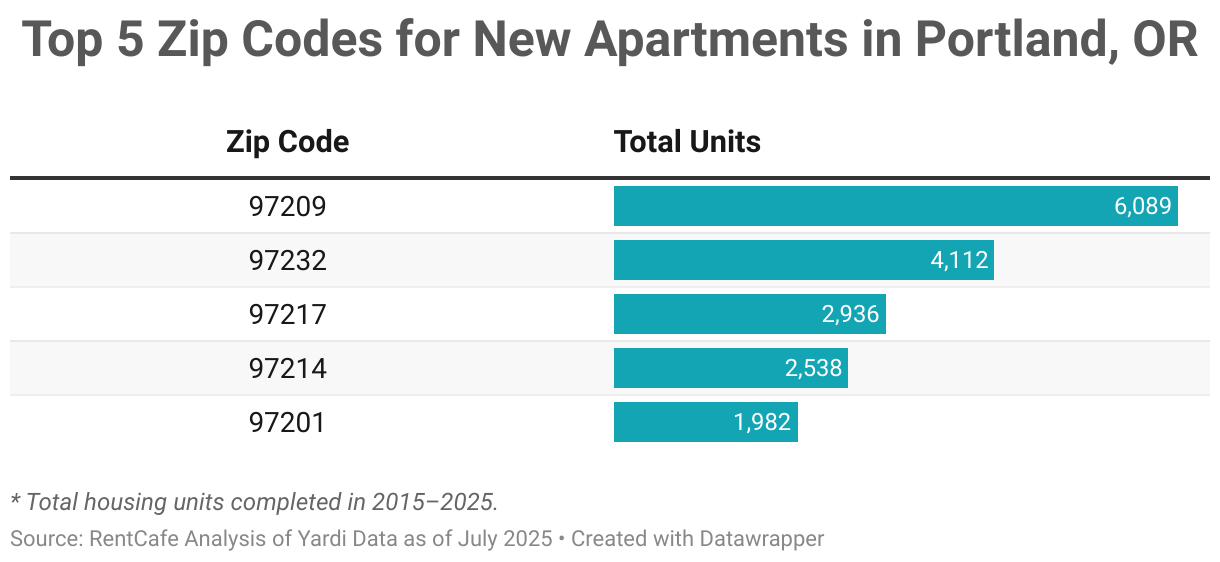
Here’s where apartment construction concentrated in the last decade:
-
- Zip code 02210 added 2,842 new apartments, the most in the metro area.
- Zip code 02118 gained 2,394 new rentals.
- Zip code 02114 welcomed 2,331 new apartments.
- Zip code 02135 added 2,044 new rentals.
- Zip code 02215 built 1,752 new apartments.
While Boston offers high-quality urban living, the cost of living here is about 1 percent lower than the state average and roughly 46% higher than the national average.
To help renters navigate these options, here’s a detailed look at the zip codes where recent construction is most active.
2,842 new apartments put zip code 02210 at the top of Boston’s construction list
Zip code 02210, covering the Seaport District (also known as the Innovation District), added 2,842 new apartments across eight developments since 2015. This area has seen a dramatic transformation from an industrial zone into a district of modern glass-and-steel towers. Residents have access to Silver Line bus rapid transit, which connects to South Station and the Red Line.
Major nearby employers include Vertex Pharmaceuticals, Mass General Brigham administrative offices, and numerous financial and technology companies located in the Innovation and Financial Districts.
Zip code 02118 added 2,394 new apartments
Zip code 02118 gained 2,394 new units across eight properties, blending new construction with its historic Victorian rowhouse character. The neighborhood is served by the Orange Line (Back Bay, Massachusetts Avenue, and Ruggles stations) and the Silver Line along Washington Street.
It is a prime location for professionals working at Boston Medical Center (located within the neighborhood) and those commuting to the Longwood Medical Area or downtown.
2,331 new apartments expand housing options in zip code 02114
Zip code 02114 added 2,331 new apartments across six communities. This neighborhood offers exceptional transit access via the Red Line (Charles/MGH), Green Line (North Station and Science Park), and Orange Line (North Station).
It is a preferred location for employees of Massachusetts General Hospital (the city’s largest private employer) and those working in state and federal government offices at Government Center.
Zip code 02135 delivers 2,044 new apartments
Zip code 02135 constructed 2,044 new units across 12 developments, serving as a primary housing hub for students and young professionals. Public transportation includes the Green Line B and C branches, though service can be slower than on other subway lines.
Major job centers and institutions nearby include Boston University, Boston College, and St. Elizabeth’s Medical Center.
1,752 new apartments grow zip code 02215’s inventory
Zip code 02215 added 1,752 new apartments in six buildings, centered around its dense cultural and educational institutions. The neighborhood is a major transit hub where the Green Line B, C, and D branches converge at Kenmore Square.
Residents are ideally positioned between downtown and the Longwood Medical Area, which houses Brigham and Women’s Hospital, Dana-Farber Cancer Institute, and Boston Children’s Hospital.
Top 5 zip codes for new apartments in Boston, MA
| Zip code | New apartments |
|---|---|
| 2210 | |
| 2118 | |
| 2114 | |
| 2135 | |
| 2215 |
* Total new apartments completed between 2015 and 2025.
Source:
RentCafe.com analysis of Yardi data as of July 2025
Boston is expanding apartment construction into new districts as growth spreads beyond the traditional core. Projects are emerging along Dorchester’s waterfront, within the Seaport’s infill zones, and near upcoming or extended MBTA stations that support transit-oriented development. Downtown and Back Bay are also seeing older office buildings converted into housing.
Outer neighborhoods such as Mattapan and Hyde Park are gaining attention for their lower land costs, enabling more affordable projects compared to central Boston. Geographic limits, historic preservation rules, and strong neighborhood resistance still constrain development, but ongoing efforts aim to balance growth with affordability and evolving urban living patterns.
FAQ: Renting in Boston’s fastest-growing zip codes
Q: How many new apartments have been built across these top Boston zip codes in total?
A: Approximately 25,625 new apartments were added across 26 zip codes in Boston over the last ten years.
Q: Which zip codes have the most new apartments in Boston, and how many were built in each?
A: Zip code 02210 leads with 2,842 new apartments, followed by zip code 02118 with 2,394 new rentals, zip code 02114 with 2,331, zip code 02135 with 2,044, and zip code 02215 with 1,752 new apartments.
Q: How accessible are Boston’s high-supply neighborhoods by public transportation?
A: Most of these neighborhoods offer high accessibility through the MBTA “T” system, including the Red, Orange, Blue, and Green lines, as well as the Silver Line bus rapid transit.
Q: Which major employers are within commuting distance of Boston’s top construction areas?
A: Major employers include Massachusetts General Hospital, Boston Medical Center, the Longwood Medical Area hospitals, Vertex Pharmaceuticals, and numerous higher education institutions such as Boston University and Northeastern.
Q: How does the cost of living in Boston compare to the national average?
A: The cost of living in Boston, MA is 1% lower than the state average and 46% higher than the national average.
Methodology
RentCafe.com is a nationwide apartment search website that enables renters to easily find apartments and houses for rent throughout the U.S.
This study uses data from 2015–2025, with the ‘past decade’ referring to this period.
Share this article:


Adina Dragos
Adina Dragos is a real estate writer and research analyst with RentCafe. She has solid experience in real estate writing, covering topics ranging from best cities for renters and the top cities for rental activity to cost of living. Her work was featured in several prominent media channels such as Axios, The Dallas Morning News, ConnectCRE and The New York Times.
Sign up for The Ready Renter newsletter
Get our free apartment hunting guide — plus local insights, trends and research.




Related posts
Detroit vs Chicago: Which Midwest city is more affordable for renters?
Detroit and Chicago are about 280 miles apart, making a move between the two a realistic option for many Midwestern renters. Maybe you’ve landed a…
Public transit options for renters in Newark, NJ: How to get around without a car
Newark renters can live car-free using PATH, NJ Transit rail, the Newark Light Rail and an extensive bus network, with Manhattan reachable in about 20…
Touring apartments in Boise, ID? Ask these questions before you sign a lease
Boise sits where high desert runs into the Rocky Mountain foothills, and it still moves at a small-town pace even as the Treasure Valley fills…
Subscribe to
The Ready Renter newsletter