Share this article:


Whether you’re moving into a new home, taking a year out of college or carrying out renovations, self storage can be an excellent service during these times of transition. The temporary storage space it offers gives you the flexibility you need to move at your own pace while providing a little breathing space in case of delays. But how much storage space do you actually need to temporarily keep your furniture away from home?
After the 5’x5′ unit, the 5’x10′ storage unit is generally the second-smallest standard size available, but you’d be surprised at how much you can fit inside. Affordable and effective, this utility room-sized storage unit could be the answer you need to the challenges of organizing your space during changing circumstances.
Estimating How Much Self Storage Space You Need
A 5’x10′ storage unit might be the second-smallest unit available, but with the typical 8-foot ceiling, it offers 400 cubic feet of total storage space. This makes it a popular choice among students when they’re looking to store the contents of a dorm room. Additionally, this size is great if you’re looking to store the belongings from a spare room or the contents of a spare room or a small apartment. You could also make use of this unit size when you’re taking up remodeling and need room to remove the contents of the areas under construction.
What Fits Inside a 5’x10′ Storage Unit?
Offering 50 square feet of floor space, a 5’x10′ storage unit is able to accommodate more items than you might initially imagine. However, it’s important to measure up any larger pieces of furniture to be sure that they’ll fit inside.
As a rule of thumb, you can expect the unit to accommodate around 10 to 15 medium-sized storage boxes, or the contents of an average-sized bedroom plus a few of those boxes. Here are some other items you might typically store in a 5’x10′ unit:
- Twin or full-size mattress
- Bedroom furniture, including chairs, lamp and dresser
- Bookcase
- Small couch
- Coffee table
- Washer and dryer
- Desk
- Bicycle and other sports equipment
- Motorcycle
- Table
- TV
- Wardrobe
- Garden and DIY tools
Packing and Stacking to Save Space
Getting the most out of a 5’x10′ storage unit requires you to pay attention to how you pack your items. If you’re unsure, you can seek the advice of a professional mover, who will have the experience needed to make the most of the full floor-to-ceiling space. However, with a few tips and tricks, you can learn to stack a lot of furniture into your unit yourself and make the most of the space.
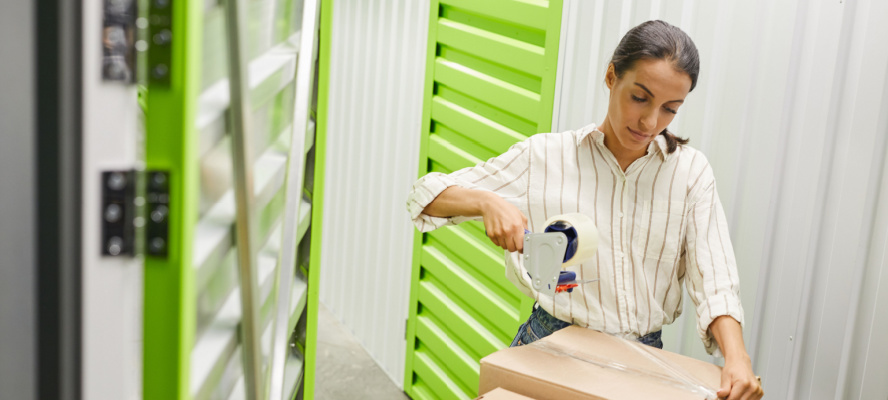
It’s best to keep the heaviest items at the bottom and build up from there. Be sure to protect anything that could tear or scratch easily, like a couch or a table, before putting additional items on top. If you’re storing a mattress, it’s best to lay it down. As such, stack all your other items first, and place the mattress on top, preferably with a protective covering.
Make the Most of Your 5’x10′ Unit
It’s important to plan ahead to be sure that a 5’x10′ storage unit is the correct size for you. Measuring up is essential, but it’s also a good idea to check the dimensions of the unit’s door. This way, you can be certain you’ll get everything inside.
If you’re struggling to visualize the space, you can normally arrange a visit in advance to see what you’re working with. Alternatively, make a sketch, either on paper or using a computer, and start planning out how everything will fit together. Be advised that a 5’x10′ storage unit is not the same as a 10’x5′ storage unit — while they both offer the same amount of space (400 cubic feet), the latter typically has a wider door but a shallower depth, which gives easier access.
Using a 5’x10′ unit for your storage needs can generate great savings over time, especially if you live in a city where apartments are small, such as in the big East Coast cities. This storage unit size can hold some of your belongings, allowing you to better enjoy your living space there. Renting a 5’x10′ unit in NYC ($257/month), Washington D.C. ($162/month), or Miami, FL ($192/month), can be a great way to offset some of the living costs that come with big-city living. Similarly, you can probably make good use of self storage in West Coast cities such as Seattle, WA ($209/month) and San Francisco, CA ($274/month), where home space often comes at a premium.
Share this article:


Mirela Mohan
Mirela is a senior real estate & proptech editor at Yardi, covering property management technology, proptech and the growing role of AI across the built environment for Yardi.com. Outside of work, Mirela enjoys reading, hiking and creating art. You can contact Mirela via email.
Sign up for The Ready Renter newsletter
Get our free apartment hunting guide — plus tips, trends, and research.




Related posts
August 2026 self storage report: Rents fall 2.2% annually as most major cities post street rate declines
National street rates averaged $134 per month in August 2026, down 2.2% year-over-year and off 0.7% from July. 71% of the 150 largest U.S. cities…

Best cities for renters to live in 2026: McKinney, TX, leads again in a South-dominated top 50
For the second year in a row, McKinney, TX, holds the top spot in RentCafe.com’s ranking of the best cities for renters. This year, Southern…

The money talk you need to have with your roommate before you co-sign a lease
Before you co-sign a lease with a roommate, you need to have an honest conversation about money. A jointly signed lease means both renters share…
Subscribe to
The Ready Renter newsletter