Share this article:


Over the last ten years, developers completed more than 33,500 new apartments across Columbus, reflecting sustained population growth in Ohio’s largest city. Apartment construction has occurred across multiple districts rather than concentrating in a single core, following employment centers, university activity, commercial corridors, and available redevelopment sites.
Which Columbus zip codes added the most apartments?
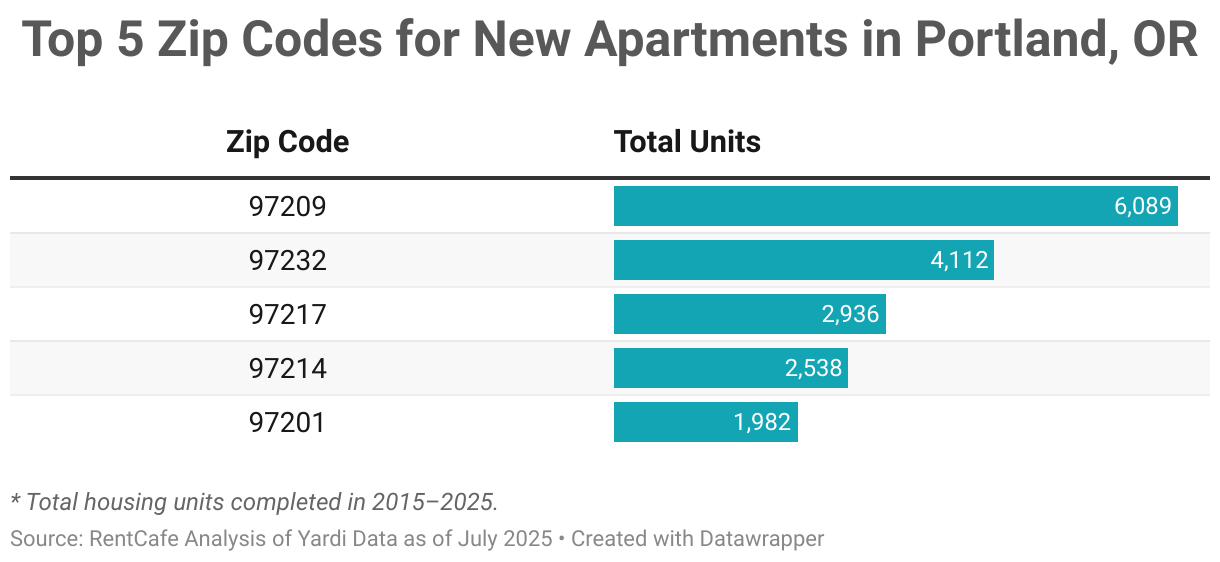
Here’s where apartment construction concentrated in the last decade:
-
- Zip code 43215 added 7,190 new apartments, the largest total in the city.
- Zip code 43201 gained 5,106 new apartments.
- Zip code 43228 added 2,688 new apartments.
- Zip code 43230 delivered 2,009 new apartments.
- Zip code 43219 built 1,911 new apartments.
Columbus’s economy is anchored by state government, higher education, healthcare, logistics, finance, insurance, and research and development. The cost of living in Columbus is 2% higher than the state average and 6% lower than the national average, making it an attractive option for residents seeking affordability alongside a diverse and expanding job market.
7,191 new apartments make zip code 43215 Columbus’s largest construction zone
Zip code 43215 added 7,191 new apartments, making it the most active area for apartment construction in Columbus over the past decade. This zip code includes downtown Columbus and adjacent areas along High Street north toward the central city.
Public transportation is provided by COTA, with multiple bus routes operating along High Street, Broad Street, and surrounding corridors. Major employers located in or near zip code 43215 include Ohio state government offices, Nationwide Insurance, Huntington Bancshares, American Electric Power, OhioHealth, and numerous legal, financial, and professional services firms. The area also contains downtown hospitals, convention facilities, and cultural institutions.
Zip code 43201 added 5,106 new apartments
Zip code 43201 gained 5,106 new apartments, reflecting sustained development around The Ohio State University and the High Street corridor north of downtown.
Transit service relies primarily on COTA bus routes operating along High Street and major cross streets, offering frequent connections between campus and downtown. Employment access is dominated by The Ohio State University, which employs more than 47,000 people across academic, research, healthcare, and administrative roles. The Wexner Medical Center, Battelle Memorial Institute, and nearby OhioHealth facilities provide additional employment. Downtown Columbus is accessible within 15–20 minutes by transit or bicycle.
2,688 new apartments expand housing options in zip code 43228
Zip code 43228 added 2,688 new apartments, representing a major share of development on Columbus’s west side. Public transportation is currently provided by COTA bus routes, with significant improvements planned through the LinkUS Bus Rapid Transit corridor on West Broad Street. Until BRT service is implemented, most commuting occurs by car.
Employment access centers on logistics and distribution, including operations from Amazon, FedEx, and UPS, as well as freight activity tied to the Rickenbacker Intermodal Facility. Downtown Columbus and state government offices are reachable via Interstate 70.
Zip code 43230 added 2,009 new apartments
Zip code 43230 gained 2,009 new apartments, concentrated near the Easton commercial corridor in northeast Columbus. Transit access currently relies on COTA bus service, with future LinkUS corridors planned to improve connections to downtown. Interstate 670 provides roadway access west to downtown, while John Glenn Columbus International Airport lies to the east.
Major employers in and near this area include L Brands, JPMorgan Chase, and numerous corporate offices, hotels, and retail operations. Airport-related employment is also easily accessible.
1,911 new apartments built in zip code 43219
Zip code 43219 added 1,911 new apartments, reflecting development near John Glenn Columbus International Airport and surrounding employment zones. Transit options are limited to COTA bus routes, and most commuting occurs by car. Interstate 670 connects the area directly to downtown Columbus and to Easton and northeast employment districts.
Major employers include John Glenn Columbus International Airport, aviation services companies, cargo and logistics operations, and the Defense Supply Center Columbus — one of the U.S. Department of Defense’s largest supply chain facilities.
Top 5 zip codes for new apartments in Columbus, OH
| Zip code | New apartments |
|---|---|
| 43215 | |
| 43201 | |
| 43228 | |
| 43230 | |
| 43219 |
* Total new apartments completed between 2015 and 2025.
Source:
RentCafe.com analysis of Yardi data as of July 2025
Columbus’s apartment construction over the past decade has occurred across multiple corridors rather than concentrating exclusively in a single district. Development has followed higher-education campuses, downtown employment centers, logistics hubs, and commercial corridors positioned for future transit investment.
State government, healthcare, research institutions, and corporate headquarters continue to shape where new apartments are built. Planned Bus Rapid Transit corridors are expected to further influence future development patterns by strengthening connections between employment centers and residential areas.
FAQ: Renting in Columbus’s fastest-growing zip codes
Q: How many new apartments were built in Columbus during the last ten years?
A: Developers completed 33,572 new apartments during this period.
Q: Which Columbus zip codes saw the most apartment construction?
A: Zip code 43215 led with 7,190 new apartments, followed by 43201 with 5,106 new rentals, 43228 with 2,688 new apartments, 43230 with 2,009 new rentals, and 43219 with 1,911 new apartments.
Q: How accessible are Columbus’s high-growth apartment areas by transit?
A: Zip code 43215 and zip code 43201 offer the strongest transit access via COTA bus routes, with additional capacity planned through the LinkUS Bus Rapid Transit network. Other areas rely more heavily on roadway access.
Q: Which major employers are located near Columbus’s largest construction zones?
A: Employers include The Ohio State University, Nationwide Insurance, Huntington Bancshares, American Electric Power, Battelle Memorial Institute, OhioHealth, JPMorgan Chase, L Brands, logistics employers near Rickenbacker, and airport-related operations.
Q: How does the cost of living in Columbus compare to the average for Ohio?
A: The cost of living in Columbus, OH, is 2% higher than the state average and 6% lower than the national average.
Methodology
RentCafe.com is a nationwide apartment search website that enables renters to easily find apartments and houses for rent throughout the U.S.
This study uses data from 2015–2025, with the ‘past decade’ referring to this period.
Share this article:


Adina Dragos
Adina Dragos is a real estate writer and research analyst with RentCafe. She has solid experience in real estate writing, covering topics ranging from best cities for renters and the top cities for rental activity to cost of living. Her work was featured in several prominent media channels such as Axios, The Dallas Morning News, ConnectCRE and The New York Times.
Sign up for The Ready Renter newsletter
Get our free apartment hunting guide — plus local insights, trends and research.




Related posts

Detroit vs Chicago: Which Midwest city is more affordable for renters?
Detroit and Chicago are about 280 miles apart, making a move between the two a realistic option for many Midwestern renters. Maybe you’ve landed a…

Public transit options for renters in Newark, NJ: How to get around without a car
Newark renters can live car-free using PATH, NJ Transit rail, the Newark Light Rail and an extensive bus network, with Manhattan reachable in about 20…

Touring apartments in Boise, ID? Ask these questions before you sign a lease
Boise sits where high desert runs into the Rocky Mountain foothills, and it still moves at a small-town pace even as the Treasure Valley fills…
Subscribe to
The Ready Renter newsletter