
Share this article:


Reporting your rent payments means sharing some personal and payment information, which may feel concerning. However, your data is kept within a regulated system. When your payments are reported to a credit bureau, federal law gives you the right to see your credit report, dispute inaccurate or incomplete information and expect limited access to your file.
Providers collect and report different information, so it helps to know what to check before you sign up for rent payment reporting. This guide explains what data is typically shared, how it’s used, who can see it and how it’s protected.
How does rent payment reporting work?
A rent payment reporting service connects your rent payments to your credit file. The process usually works like this:
- You pay rent through your resident account, your property’s payment portal or a reporting service.
- The reporting service records the payment details.
- The service sends the data to one or more of the three nationwide credit bureaus: Equifax®, Experian® and TransUnion®.
- The bureaus add it to your credit file.

Providers may differ in two ways worth knowing about:
- Some providers, like RentCafe’s partner IdentityIQ®, report only on-time payments, while others include late ones as well.
- Some providers, including IdentityIQ®, report to all three nationwide credit bureaus; others report to only one or two.
Before activating rent payment reporting, ask which bureaus receive your information, what payment statuses are reported and when reporting begins.
What data do rent payment reporting services share?
Rent payment reporting generally involves two types of information:
Payment information
- The rent amount
- The payment due date and the date you paid
- Whether you paid on time (and, with some services, whether it was late or missed)
Identifying information
The credit bureau needs enough information to match the payment to the right person. A provider may share:
- Your name and the rental address
- Other details the provider needs to match you to your credit file, which may include your date of birth or Social Security number
Some services verify your payments by connecting to your bank account or by asking for documentation. If a service asks to link a bank account, review what permissions you’re granting before you agree.
How is your rent payment data used?
Once reported, your rent payments are added to your credit file as payment history. Rent is typically reported like a loan payment, as a set amount due each month. It isn’t treated like a credit card balance, so it generally won’t change how much of your card limit you’re using, which is one factor in your credit scores.
Not every credit-scoring model considers rental history. Lenders also choose different scores for different decisions. On-time rent may help a score that considers rental history, but an increase is not guaranteed.
To understand how each provider handles other information it collects, you can review its privacy policy.
Who can see your rent payment data?
- Your property manager and reporting provider can see the payment records they handle.
- The credit bureaus that receive the information store it in your credit file.
- Lenders, card issuers and other businesses with a legitimate reason to check your credit, such as a loan or credit card application, may see your rent payments when they review your report.

A landlord or property manager needs a permissible purpose under the Fair Credit Reporting Act (FCRA) to obtain your credit report. Screening a rental application you submitted can qualify as a permissible purpose, which means a valid legal reason. For rental screening, landlords or property managers often ask you to authorize the check in the application. Signing up for rent payment reporting doesn’t give your landlord access to your credit report.
Credit report vs. tenant screening report
A credit report is different from a tenant screening report. A tenant screening report may combine rental history, eviction records, employment verification, criminal history and other information from a credit report. Rent payment reporting is a separate process, although one company may offer both services. Ask the company which report it requires when you apply for an apartment.
How is your rent payment data protected?
In the U.S., the FCRA governs consumer credit information and can give you these protections:
- Access. You can review a free report from each nationwide credit bureau every week at AnnualCreditReport.com, the official source. Use these copies to confirm what’s being reported about your rent.
- Accuracy and disputes. If information on your credit report seems inaccurate, you can dispute it with the credit bureau and the company that supplied it. The bureau must investigate and correct any inaccurate information. If the dispute isn’t resolved, you can ask the bureau to add a brief statement of the dispute to your file.
- Limits on access. A person or business must have a permissible purpose under the FCRA to obtain your credit report.
Is rent payment reporting optional?
Rent payment reporting is usually voluntary and requires your consent, though how it’s offered varies. Some properties include it as an opt-in feature, while others work with services you sign up for yourself, IdentityIQ®.
Before activating a reporting service, find out:
- Whether there’s a fee to activate the service
- Whether you can cancel at any time
- What happens to data that’s already been reported if you cancel
Reporting your rent payments through RentCafe
If you rent at participating RentCafe properties, you can join the RentCafe Rewards loyalty program and activate rent payment reporting* for free in your RentCafe account.
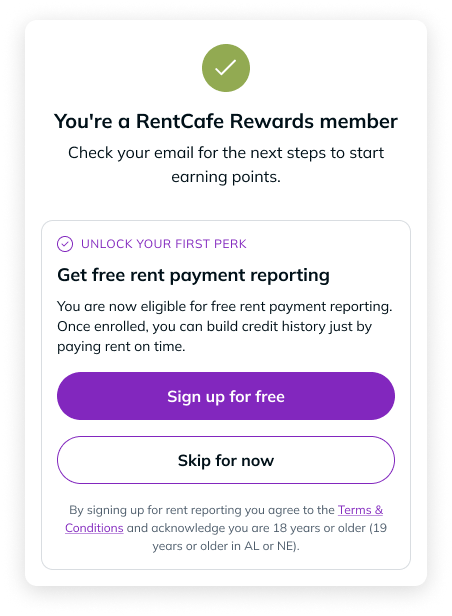
The service is powered by IdentityIQ® and sends only your on-time payments to all three major credit bureaus: Equifax®, Experian® and TransUnion®. You keep paying rent the same way as before. Optional paid upgrades may also be available.
Not at a participating property? Ask your property manager what options your community offers.
*Available at select RentCafe partner properties.
Share this article:


Roxana Nica
Roxana Nica is a senior real estate writer with RentCafe and ResidentShield, bringing over six years of experience in crafting digital content across various consumer industries, including fashion and interior furnishings. She develops resources that address the everyday needs of renters, from smart living tips to navigating residential services. Roxana holds a B.A. in International Relations and an M.A. in Advertising.
Sign up for The Ready Renter newsletter
Get our free apartment hunting guide — plus apartment living tips, trends and research.




Related posts

Rent payment reporting: How your data is used and protected
Reporting your rent payments means sharing some personal and payment information, which may feel concerning. However, your data is kept within a regulated system. When…

RentCafe Rewards helps you build your credit history with free rent payment reporting
Did you know that joining RentCafe Rewards can help build your credit score? That’s because RentCafe Rewards members can activate rent payment reporting* at no…

RentCafe simplifies how you pay rent with flexible rent
Paying rent just got more flexible for RentCafe members. With the flexible rent integrated directly into RentCafe, you now have the option to split your…
Subscribe to
The Ready Renter newsletter