
What is a guarantor and when do I need one on my lease?
Summary
A guarantor is a financially responsible third party who agrees to cover your rent if you’re unable to pay, which can help you qualify for an apartment you might not be approved for on your own. You likely need a guarantor if your income is below 2.5-3x the monthly rent, your credit score is under 670 or you have a limited rental history.
What is a guarantor?
A guarantor is a financially stable person — often a family member, close friend or sometimes a professional service — who agrees to cover your rent if you can’t.
Think of a guarantor as added financial security for the property manager. When you sign a lease with a guarantor, that person co-signs a separate agreement promising to step in and pay what you owe if you fall behind. This arrangement is different from a co-signer, although the terms are often used interchangeably. A co-signer shares equal legal responsibility for the lease from day one and has the legal right to live in the apartment, while a guarantor does not — they simply guarantee that the financial obligations of the lease will be met.
Here’s a practical example: Imagine you’re applying for an apartment that costs $1,500 a month, but your annual salary is $38,000. That puts your income just below the typical requirement of 3x the monthly rent ($54,000 in this case). A guarantor bridges that gap by assuring the property manager that the rent will be paid regardless.
A guarantor’s obligation is legally binding. If you fail to pay rent, the property manager can require the guarantor to cover the missed payments. Any failure to do so may negatively impact the guarantor’s credit score and financial stability. For this reason, both selecting a guarantor and agreeing to take on that role should be considered carefully.
Who can be a guarantor?
Now that you know what a guarantor does, the next question is who actually qualifies. Identifying the right guarantor is important because this person is responsible for covering your rent if you can’t.
Common guarantor options include:
- Parents or family members — the most traditional choice, especially for first-time renters and students.
- Close friends or mentors — less common, as the financial risk can strain relationships.
- Institutional or third-party guarantor services — companies that act as your guarantor and are a valuable option if you don’t have a personal contact who qualifies. These services typically charge a fee based on a percentage of the annual rent. Ask the provider for their exact pricing.
Requirements can vary widely by location or property, so confirm the criteria before asking someone to be your guarantor. Keep in mind that guarantors are usually held to higher financial standards than renters to ensure they can reliably cover the lease if needed.
A guarantor typically pays a separate application fee and must provide proof of income or employment, along with a valid government-issued ID.
Most property managers require a guarantor to meet the following criteria:
- Strong income. A common rule of thumb is that guarantors are expected to earn 24-36x the monthly rent annually, or roughly 2-3x the monthly rent each month. For a $1,500 apartment, that could mean an annual income ranging between $90,000 and $120,000. However, in some high-cost rental markets (particularly in New York City), guarantors are expected to earn 60-80x the monthly rent annually, or 5-6x the monthly rent each month.
- Good credit. A credit score of 670 or higher is often expected, though requirements vary by property and location.
- Stable employment. Verifiable, consistent employment or documented income sources are typically required.
How do I know if I need a guarantor?
Not every renter needs a guarantor. Knowing where you stand can save you time during your apartment search.
Here are some common situations where a property manager may ask you to add a guarantor to your rental application:
You likely need a guarantor if any of the following apply to you:
- Your income doesn’t meet the threshold. Most property managers require gross income equal to 2.5-3x the monthly rent. If the apartment you want is $1,800/month and you earn less than $4,500-$5,400 per month before taxes, a guarantor may be necessary.
- Your credit score is below 670. A lower score can signal higher risk to property managers. Some may accept scores around 620-650, while others require 700 or higher, depending on the market and property.
- You have limited or no rental history. First-time renters, recent graduates and anyone who hasn’t held a lease in their own name before may be asked for additional assurance.
- You’re self-employed or have irregular income. Even with strong earnings, inconsistent pay can raise concerns for property managers, especially without standard pay stubs to verify your income.
- You have a prior eviction or broken lease. A mark on your rental record can lead property managers to require a guarantor.
If you decide you need one, you can add a guarantor through the Applicant Portal even after you’ve submitted your application and paid the required fees. You don’t always have to designate a guarantor before submitting your application.
You probably don’t need a guarantor if:
- Your income comfortably exceeds 3x the monthly rent.
- Your credit score is 670 or above.
- You have a solid history of on-time rent payments and positive references from previous property managers.
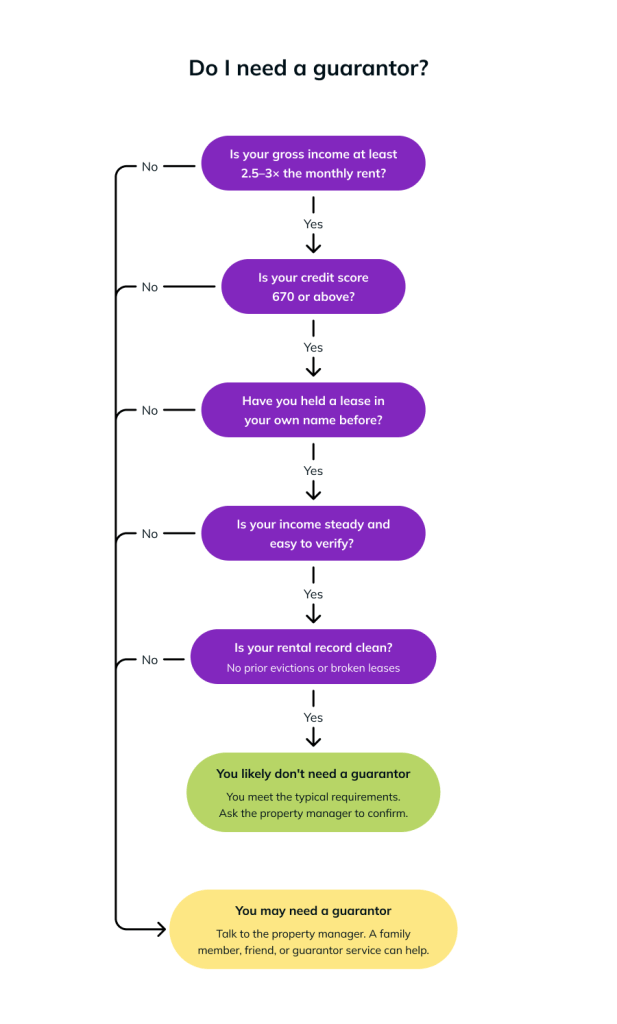
Before you apply, ask the property manager about their specific income, credit and guarantor requirements. This way, you’ll know exactly where you stand and can prepare accordingly.
Ready to start your apartment search? Browse listings on RentCafe to find apartments that match your budget and contact the property manager directly to ask about their guarantor requirements.
FAQ
Yes. Property managers may also consider credit, employment or rental history, so meeting the income threshold doesn’t always guarantee approval. Requirements vary by property and location.
Your property manager can require your guarantor to cover the unpaid rent, which may impact their credit and finances. That’s why it’s important to communicate openly and take the arrangement seriously.
Some property managers allow you to remove a guarantor at lease renewal if your financial situation has improved. This isn’t guaranteed, so ask about the policy upfront.
You can use a third-party guarantor service. These companies back your lease for a fee — typically 60-90% of one month’s rent paid upfront, annually or in monthly installments, or a flat percentage of annual rent. Compare terms carefully before committing.
Your guarantor is typically responsible for the same obligations. If you don’t cover early termination fees or remaining rent, the property manager can require the guarantor to pay.